
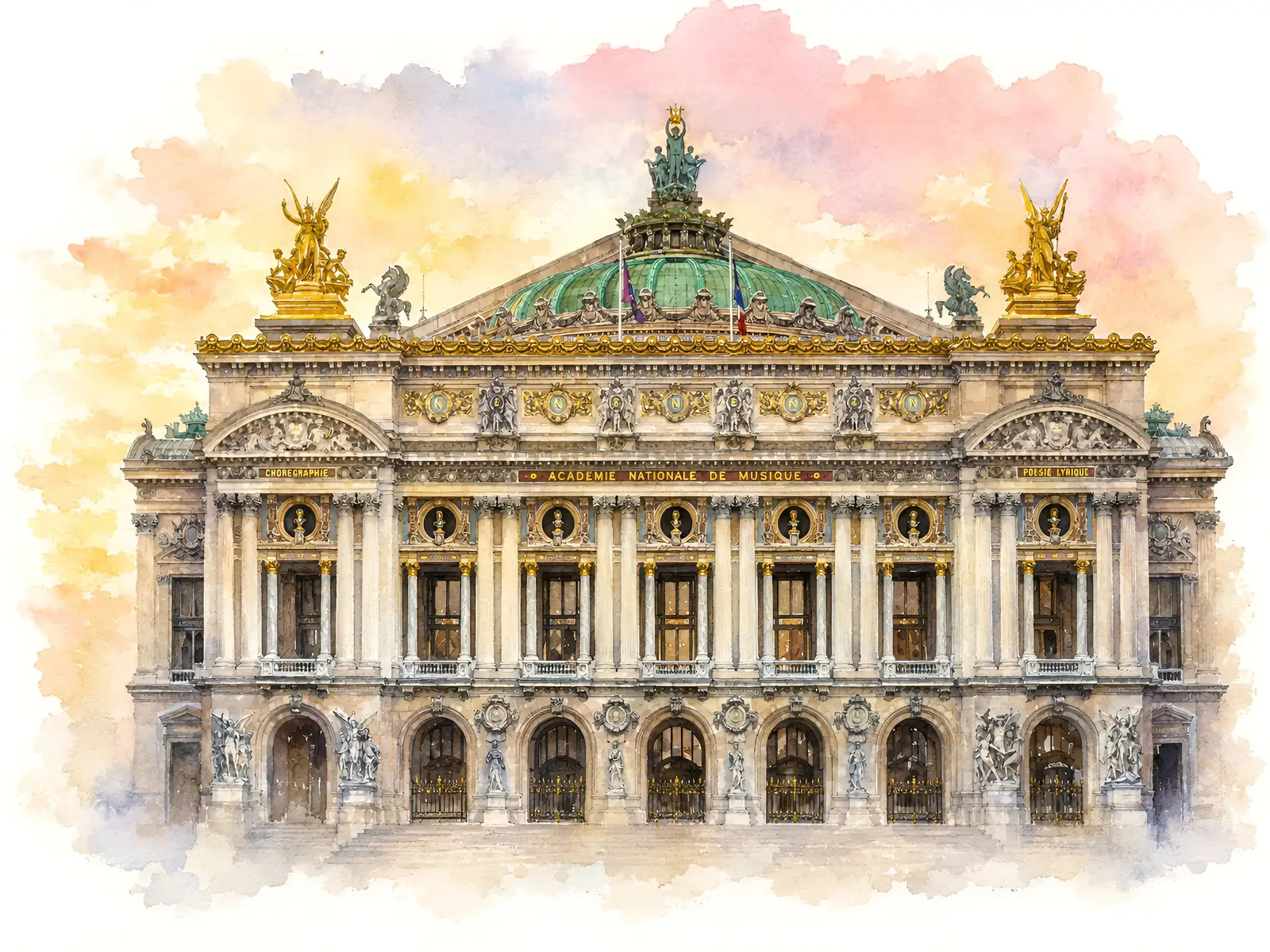
Opéra Garnier
In 1861 the competition for a new opera house drew 171 entries. It was won by an unknown thirty-five-year-old named Charles Garnier.
When Empress Eugénie asked what style the building was in, neither Greek nor Roman as far as she could tell, Garnier is supposed to have answered that it was in the Napoleon III style, Madame. He was being polite about an argument he had already won. The building borrows from the Baroque, from Palladio and from the Renaissance, and resolves into something that had not existed before.
It opened in January 1875, by which point the Second Empire had fallen and Napoleon III was dead.
Isidore Pils painted the ceiling over the Grand Staircase and Paul Baudry the one in the Grand Foyer. In 1964 Marc Chagall added the auditorium ceiling, twelve canvas panels and a central roundel across some 240 square metres, laid over the original and still argued about sixty years later. The lyre is the motif running through everything, down to the door handles and the heating grilles.
The seven-tonne chandelier has its own history. In 1896 one of its counterweights fell into the audience and killed a concertgoer, which is where Gaston Leroux found his phantom.
Here is what matters for a wedding. This is a building whose entire design problem was how a few thousand people arrive, are seen, and move between rooms. Nothing else on the list solves that better, because nothing else was built to solve it at all.
We are not affiliated with the Opéra national de Paris.
Opéra Garnier Wedding Venues
Here is how we build the evening, and the architecture leaves very little to argue about.
Guests come up off Place de l’Opéra into the Grand Staircase, which is where the ceremony happens. Cocktails follow in the Avant-Foyer, directly above and looking back down onto the stairs everyone has just walked. Dinner is in the Grand Foyer next door, and the night finishes there or in the auditorium with something staged.
The staircase, the room above the staircase, the gallery beyond it. Nobody is ever walked anywhere.
The honest limitation is that these rooms are vast and empty. Everything a wedding needs arrives on a lorry and leaves the same night, and whatever will not fit through the doors cannot be part of the design.
The Grand Staircase
White marble rising through the centre of the building, the balustrade in red and green marble, torchères held by bronze figures, and the Pils ceiling overhead. The ceremony goes here.
It is the only ceremony space we would consider in the building, and it does something no other venue in Europe can. The guests are above you. They line the landings and the foyer openings and look down, which turns a processional into a piece of theatre staged in the round.
The Avant-Foyer
Directly above the staircase, its vault covered in mosaic with gold behind the colour, and a view back down over the Carré des Caryatides. Cocktails for up to 700.
Take the cocktail here and nowhere else. Guests have just watched the ceremony from this room and they get to stay in it, which spares everyone the transition that usually kills the hour after a ceremony.
The Grand Foyer
Garnier designed it after the great galleries of the classical châteaux, and it is the nearest thing in France to the Hall of Mirrors at Versailles that anybody can actually hire. Mirrors, windows, Baudry’s ceiling on musical themes, and Carpeaux’s bust of Garnier at the centre. The Loggia at the end opens onto the Avenue de l’Opéra.
With the Avant-Foyer it seats 700 for dinner. Long tables down the length of it rather than rounds, every time. The room is a gallery and it wants to be read as one.
The Rotonde des Abonnés
The circular room where subscribers once entered from the east façade, now the Opera Restaurant, with the Pythia fountain beyond it beneath the staircase. 400 for a cocktail, 200 seated.
This is the room for a wedding that is not trying to fill the building. Two hundred people here feels considered rather than thin.
The Rotonde du Glacier
Light and airy and later than the rest of the house, with Clairin’s painted ceiling and tapestry cartoons of hunting and fishing. It carries a 1900s feel the rest of the building does not. 200 for a cocktail, 100 for dinner.
The smallest useful room in the Palais Garnier, and the one we would take for a rehearsal dinner the night before.
The Auditorium
Red and gold, 2,051 seats, the Chagall ceiling and the chandelier above them. Hired for a private ballet, opera or recital rather than for dining.
If you are going to do this, do it after dinner rather than before. An audience that has eaten and drunk together watches differently, and the walk back out through the foyers afterwards is the last thing anyone will remember.
Opéra Garnier Location
Place de l’Opéra is the hinge of the Right Bank, where Haussmann’s avenues converge and the Avenue de l’Opéra runs straight down towards the Louvre.
Everything is walkable from here, which for a Paris wedding is the whole logistical argument.
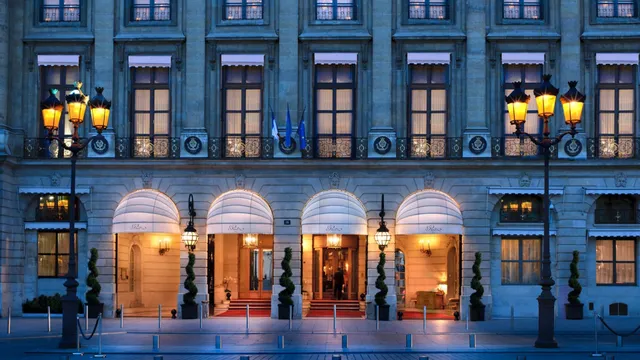
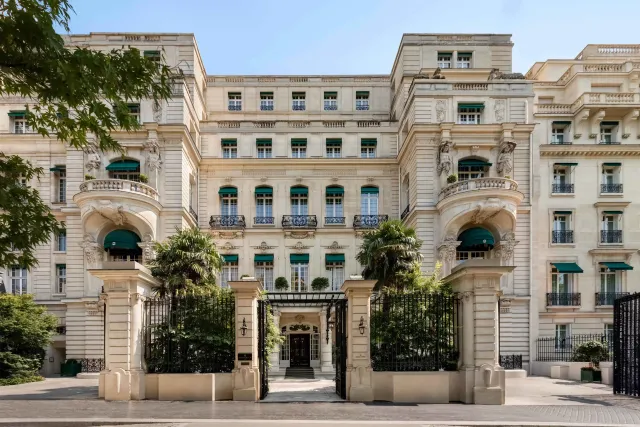
The Palais Garnier has no bedrooms, and that turns out to help. More palace hotels sit within a few minutes of this square than of anywhere else in Europe, so the guest list is spread across two or three of them by preference and by budget rather than compressed into one property’s room count.
By commercial flight
Charles de Gaulle (CDG) is 45 to 60 minutes depending on traffic and takes direct routes from almost everywhere in the world. Orly (ORY) is 35 to 45 minutes and serves more of Europe and North Africa.
We move American and Asian guests through Charles de Gaulle without exception, because Paris is the one destination where the connection is never the problem.
By private aviation
Paris-Le Bourget is Europe’s busiest business aviation airport and the closest of the three to the Opéra, about 25 minutes by road.
By rail
Eurostar from London St Pancras reaches Gare du Nord in a little over two hours, and the Opéra is ten minutes on from there. For a British guest list this beats flying comfortably enough that we build the transport plan around it.
Less than 3 months to plan all 5 parties and so many smaller experiences for our exact preferred dates in August. You're real magicians.
Opéra Garnier Wedding Cost
The structure here is different from a hotel’s, and understanding it early saves a great deal of arithmetic later.
The hire
Over €300,000, plus a percentage of what you spend on catering.
That second part is the one people miss. The venue cost is not flat: it rises with the guest list and with the menu, so a decision about food is also a decision about the hire. That matters before the guest list is settled rather than after.
What the building does not supply
Everything. No tables, no chairs, no glassware, no kitchen, and no wedding team of its own. Every plate arrives that afternoon and leaves that night.
Decoration is where that bites hardest, and it is not the place to economise. The rooms are enormous, they are already ornate, and a half-dressed Grand Foyer looks considerably worse than an undressed one. Florals, entertainment, photography, production and the conservation measures a national monument requires all sit alongside it.
We recommend budgeting from €1,000,000 all-in. A wedding that also takes the auditorium for a private performance is a different order again.
The calendar
The weather never decides anything here, and almost everyone takes the wrong lesson from that. An indoor Paris venue sounds like a year-round venue, and this one is the exception on the whole page.
The Palais Garnier is a working opera house, and it accepts an event only on a date it is not already holding for a performance. In practice that is the dark period between the seasons, roughly mid-July to mid-September. A February wedding in these rooms would photograph beautifully and is very unlikely to be a date the theatre can sell you.
Empty days do fall inside the season, and they are the only way to hold these rooms outside the summer, so we watch for them. They surface late, they go quickly, and no wedding can be planned on the assumption that one will appear. The performance calendar is also published far less far ahead than a wedding is planned.
The building is open to visitors during the day, and some installations need it closed to the public, which is a cost as well as a permission.
Opéra Garnier is perfect for
- Up to 700 seated
- €1,000,000+
- Mid-July to mid-Sept
Magic Day Insights
The room is already decorated. The instinct at a venue like this is to bring more, and it is the wrong instinct. Baudry’s ceiling and the gilding are the design, and the job of the florals and the lighting is to make people look up at what is already there. We spend the lighting budget on the architecture and the floral budget on the tables.
Long tables, always. Rounds in the Grand Foyer fight the gallery. The room is a corridor of light and mirrors and it wants a line down the middle of it.
The window is the theatre’s dark weeks. The window is the theatre’s dark weeks, mid-July to mid-September, and everything else is an opening in a published programme that appears late. We always open with those summer dates, and we keep a couple who want the season on standby with the design already agreed, because a date that surfaces in the programme will not wait for a decision.
The load-in is the project. Nothing lives in this building. Catering, furniture, plate, sound, lighting and staging all arrive inside a window the theatre sets, through a building designed in 1861 for scenery rather than for a wedding. We plan the load-in before we plan the design, and it is the single strongest reason to work with someone who has done it here before.
The performance goes after dinner. Guests watch better when they have eaten, and the walk back out through the foyers at midnight is the image that stays with them.
A backstage tour. While the couple are away being photographed, guests can be taken behind the auditorium. It fills the dead hour better than a second round of canapés, and it is the part they talk about afterwards.
Entertainment. The room sets the register. Classical performers belong here more naturally than anything amplified, and a soloist who normally plays concert halls will do something different in a space this ornate.
Weighing up Opéra Garnier?
INQUIREIf you love Opéra Garnier…
Opéra Garnier Wedding Planner
The Palais Garnier hires you its rooms and nothing else. No kitchen, no furniture, no glassware, no wedding team of its own, and a monument’s conservation rules across every decision. Catering, florals, lighting, sound, entertainment, photography and the whole production are brought in, built and struck inside a window the theatre sets.
What a first-timer misses is that the constraints all point the same way. The hire rises with the catering spend, the load-in window is fixed by the performance schedule, the finish time is contractual rather than negotiable on the night, and the guest list has to be housed across several hotels. None of those is difficult alone. Together they mean the timeline is designed backwards from the theatre’s calendar rather than forwards from the couple’s.
Magic Day plans weddings at the Opera Garnier at any scale the building holds, from a hundred in the Rotonde des Abonnés to 700 down the Grand Foyer, from the first conversation to the final farewell.
The date and the finish time come first. Everything else in this building is design.
Common Questions
How much does an Opera Garnier wedding cost?
An Opera Garnier wedding runs from €1,000,000 all-in. The hire of the Palais Garnier is over €300,000, plus a percentage of what you spend on catering, so the venue cost rises with the guest list rather than sitting flat. The building supplies its rooms and nothing else, so catering, furniture, decoration, lighting, florals, entertainment, photography and production are all budgeted on top of it.
How many guests can an Opera Garnier wedding hold?
The public rooms of the Palais Garnier together take up to 2,000 guests for a cocktail or 700 seated. The Avant-Foyer and Grand Foyer combined seat 700 for a gala dinner, the Rotonde des Abonnés holds 400 for cocktails or 200 seated, and the Rotonde du Glacier 200 for cocktails or 100 for dinner. The auditorium seats 2,051 for a private performance.
Can we marry legally at the Palais Garnier?
No. French law places the civil ceremony at the mairie and attaches a residency requirement that rules out most foreign couples. Couples marry legally at home first and hold a symbolic ceremony at the Opera Garnier, on the Grand Staircase, with guests watching from the foyers above.
What is the music curfew at the Palais Garnier?
There is no neighbourhood curfew to work around at the Opera Garnier, because everything happens inside a theatre built for sound. The end time is written into the hire contract instead, and it is set by the building's own schedule: the house has to be emptied and put back before whatever the Opéra national de Paris has staged the following day. We settle that finish time before anything else in the timeline, because every other hour of the evening is measured backward from it.
Where do guests stay for an Opera Garnier wedding?
The Palais Garnier has no bedrooms. It is a working opera house, so the accommodation is a separate exercise, and that is an advantage rather than a limitation here. Place de l'Opéra sits within a few minutes of more palace hotels than anywhere else in Europe, so a guest list can be spread across two or three of them by preference and by budget rather than squeezed into one property's room count.
Which airports serve the Palais Garnier?
Charles de Gaulle (CDG) is 45 to 60 minutes from Place de l'Opéra depending on traffic and carries direct routes from almost everywhere. Orly (ORY) is 35 to 45 minutes. Paris-Le Bourget is the private aviation airport and is the closest of the three, about 25 minutes. Eurostar from London reaches Gare du Nord in a little over two hours, and the Opera Garnier is ten minutes from there by car.
What is the wedding season at the Opera Garnier?
Mid-July to mid-September, and this is the opposite of what couples expect from an indoor Paris venue. The theatre takes an event only on a date it is not already holding for a performance, so the window is its own dark period in the summer rather than the whole calendar. Empty days do appear inside the season and we do catch them, but they surface late and cannot be planned around. The weather is irrelevant here; the programme is everything.
Can we book the Palais Garnier on any date?
No, and this is the first constraint to settle. The Palais Garnier is a working theatre, so any date already held for a performance is unavailable, and that calendar is published far less far ahead than a wedding is planned. The building is also open to visitors during the day, and some installations require closing it to the public, which adds cost.
Can we have a private performance at the Opera Garnier?
Yes. The auditorium seats 2,051 beneath Marc Chagall's 1964 ceiling and the seven-tonne chandelier, and it is made for a private ballet, opera or recital. Classical performers suit the room most naturally, and it will flatter them more than any stage they are used to.
Do we need a wedding planner for the Opera Garnier?
Yes, and more so than at any hotel. The Palais Garnier supplies the rooms and nothing else: no kitchen, no furniture, no wedding team of its own, and a monument's conservation rules over every decision. Catering, furniture, florals, lighting, sound, entertainment, photography and the entire production are brought in and taken out inside a window the theatre sets. Magic Day plans weddings at the Opera Garnier from the first conversation to the final farewell.
Thinking about Opéra Garnier, or still comparing?
Tell us what you have in mind. You don't need dates or numbers yet.
Thank you — we have it.
One of our planners will be in touch personally, usually within one working day.