
What a Montenegro Wedding Costs
A Montenegro wedding runs €30,000 to €250,000 all-in for 40 guests, €60,000 to €400,000 for 80, and from €150,000 at 150. Catering is €80 to €200 a head before drinks. Magic Day weddings in Montenegro start from €100,000.
Montenegro costs less than the French Riviera at the same standard, and couples want to know what they are giving up for it.
Mostly nothing, at the venue. The properties on this page are current five-star hotels with the same brands behind them that operate on the Côte d’Azur, and the buildings are older and in several cases more beautiful. A palace on the water at Perast costs a fraction of a palace on the water at Cap-Ferrat because Montenegro is a country of 620,000 people with a shorter season and cheaper land, not because the palace is worse.
Where it costs you is everything the venue does not own.
Montenegro’s supplier base is thin. There is no local equivalent of the production companies, floral studios and technical crews that a Riviera wedding draws on without anyone noticing, so above a certain standard the people and the kit travel in from Belgrade, Zagreb, Italy or Croatia. That is a line in a Montenegro budget which does not appear in a Provence one, and it is the most common reason a first estimate here turns out to be optimistic.
The compensations are large and they are not only financial. Guest accommodation runs at a fraction of Monaco’s, because Montenegro has a full range of hotels rather than five-star and nothing. Buyouts that are unthinkable elsewhere are merely expensive here: taking a whole hotel for four days is a normal conversation in the Bay of Kotor.
And the legal ceremony costs about €100, which is the cheapest line on the page and the one that changes the wedding most.
Montenegro Wedding Venues
Eight properties take a full wedding in Montenegro. That is not a shortlist drawn from a larger field, which is what a venue section usually is; at this standard it is close to the entire country, and the shortness of the list is the most useful thing to understand before choosing.
The table sorts by seated capacity, and what falls out of that ordering is worth saying aloud.
The most recognisable address in Montenegro is seventh of eight. Aman Sveti Stefan is the picture on the front of every article ever written about this coast — and it takes about 60 guests. Couples arrive holding that image and a list of 140 people, and the conversation that follows is the one this page exists to have early rather than late.
Regent Porto Montenegro Wedding
A Venetian-styled marina village on the Tivat waterfront, built over the Austro-Hungarian naval arsenal that stood here for a century, with superyachts moored along the quay in front of the hotel.
Regent seats up to 300 and holds more than 800 square metres of function space, including the Teodo ballroom and an Italianate waterfront garden that takes 100 seated or 250 standing. There are 149 rooms, suites and penthouses.
This is the large-wedding answer in Montenegro and there is no close second. Three hundred people can be fed properly here, the site is flat, and a truck can reach the door, which is not true of Perast, Mamula or Sveti Stefan.
The trade is character. Porto Montenegro was built in the last twenty years and it looks it, so a couple who came to the Adriatic for stone and centuries will not find them in these photographs. We send big weddings here and small ones elsewhere, and we say which is which at the first meeting.
One&Only Portonovi Wedding
On the northern shore where the Bay of Kotor meets the open Adriatic, twenty minutes from the Croatian border, with a marina below and the Luštica peninsula across the water.
Portonovi opened in 2021 with 105 rooms, 6 suites and 12 villas, several of the villas with their own pools and beach. Weddings run to 220 across the ballroom and gardens, and up to about 300 outdoors on the seafront lawns. The Boka Garden is the ceremony space.
Of the eight, this is the one we recommend most often for a wedding of three or four days. It has enough rooms to sleep most of a guest list, enough separate spaces to run a welcome party, a wedding and a farewell lunch without repeating a room, and it is closer to Dubrovnik airport than anything else here.
What it does not have is age. It is a new resort and it feels like one, and the couples who love it are the ones who wanted the water rather than the history.
Talici Hill Wedding
A restored 17th-century stone estate in the hills above Sutomore, olive groves and fruit gardens around it, 5,000 square metres of private garden and the sea somewhere below through the trees.
The villa runs to 450 square metres with six bedrooms sleeping 16 to 18, a heated pool and a 100 square metre event room. The forecourt takes 50, the pool terrace another 50, and the lower lawn seats up to 250.
This is the only property on the list that works the way a French estate works. You take the whole place, nobody else is there, you bring your own people and you build the wedding you want on ground that belongs to you for the weekend. Montenegro has almost none of that, and it is what most couples arriving from a Provence search are actually looking for.
Two honest limitations. It is roughly an hour and a half from Tivat and well away from the bay, so it is a commitment rather than a base. And six bedrooms against 250 seated means the guest list sleeps down the hill in Bar or Sutomore.
Heritage Grand Perast by Rixos Wedding
An 18th-century palace on the waterfront of Perast, a UNESCO-listed town of stone houses and sixteen churches where no cars are allowed, with two islands sitting offshore in the middle of the bay.
The hotel holds 130 rooms and suites behind the palace façade and takes weddings of 40 to 120, with a terrace on the water.
Perast is the most beautiful place in Montenegro and this is the only serious hotel in it. Our Lady of the Rocks, the man-made island five hundred metres offshore, is an active Catholic church that holds weddings, so a ceremony there and a boat carrying every guest back to the hotel steps is a real day rather than a fantasy. Settle the church with the diocese before the date, not after.
The limitation is that Perast is small and public. A wedding here happens in front of the town rather than away from it, and in August the same quay carries day-trippers all afternoon.
Mamula Island by Banyan Tree Wedding
A circular Austro-Hungarian fort of 1853 on a small island at the mouth of the Bay of Kotor, restored and opened as a hotel in 2023, reached only by boat.
Thirty-two keys, 10 rooms and 22 suites, across the heritage chambers and a contemporary wing. Three pools, a sand beach, a sun deck facing the open Adriatic, and weddings of 25 to 100. The whole island goes privately, which is the reason to look at it. Hire is priced as a buyout, with the rooms, the boats and the catering folded in, rather than as a fee for the space.
Nowhere else in the Adriatic offers a private island at this standard. The guest list is the only guest list on the island, the last boat leaves when you say it does, and the noise question that shapes every other wedding in this country largely stops existing.
Now the part no listing includes, and it should come from us rather than from a plaque. Italian occupying forces used this fort as a prison camp in 1942 and 1943. More than two thousand people were held here, and people died here. The conversion to a hotel was contested in Montenegro and remains so for some Montenegrins.
That is not a reason not to marry here — it is a conversation to have with your family before the invitations rather than after somebody looks it up.
Savina Winery Wedding
A hillside above Herceg Novi beside the Savina monastery, vines running down toward the water, the only working winery on the Montenegrin coast.
Savina takes 10 to 80 guests across its hall and terraces and has no rooms of its own.
We use this more often for a welcome dinner than for a wedding, and that is a recommendation rather than a demotion. Eighty people among vines above the bay on the Thursday sets up a wedding somewhere else on the Saturday better than any hotel reception does, and it costs a fraction of adding a night to a five-star property.
As a wedding venue it works at 60 and stops working at 80. It is a working winery with a harvest to bring in, so September dates need asking about early.
Aman Sveti Stefan Wedding
A fortified fishing village of the fifteenth century on its own islet, pink stone and red roofs, joined to the mainland by a causeway, the whole village a single hotel. Villa Miločer sits on the shore opposite, once the summer residence of Queen Marija Karađorđević, with Queen’s Beach beyond it.
Fifty-eight keys in total, 50 on the island and eight at Villa Miločer. Weddings run to about 60, with more possible across the terraces and lawns at a full buyout, and buyouts happen in July and August.
The thing to know before falling for it is that it has just come back. Aman closed Sveti Stefan in 2021 in a dispute over public access to the beaches, and it stayed shut for five years. Villa Miločer reopened on 22 May 2026 and the island on 1 July, under a settlement that opens two of the three beaches to residents and keeps Queen’s Beach for guests.
So the most photographed wedding venue in the country is also the one nobody has a current operating record with. It is extraordinary and it is small, and a 2027 date here is a decision made on a five-year-old reputation and one reopened season.
Ćatovića Mlini Wedding
Three-hundred-year-old watermills at Morinj, halfway between Herceg Novi and Kotor, where a stream comes off the mountain into the bay through stone bridges, bamboo and trout ponds. The Ćatović family milled flour here for two centuries before it became a restaurant thirty years ago.
It seats about 50 and has no rooms. The whole place closes to the public for you at a price, and dinner in the restaurant comes with the hire rather than beside it.
This is one of two or three restaurants in Montenegro worth crossing the bay for, and fifty people at long tables over running water under old trees is the meal your guests will still be describing a year later.
Treat it as the welcome dinner rather than the wedding. Fifty is fifty, there is nowhere to sleep, and it is a restaurant closing its doors for an evening rather than a venue with a wedding infrastructure behind it.
Where to Marry in Montenegro
The whole coast is 120 kilometres and the wedding country inside it is far shorter than that.
Herceg Novi to Budva is under an hour when the ferry is running, and every property on this page sits in one of four places.
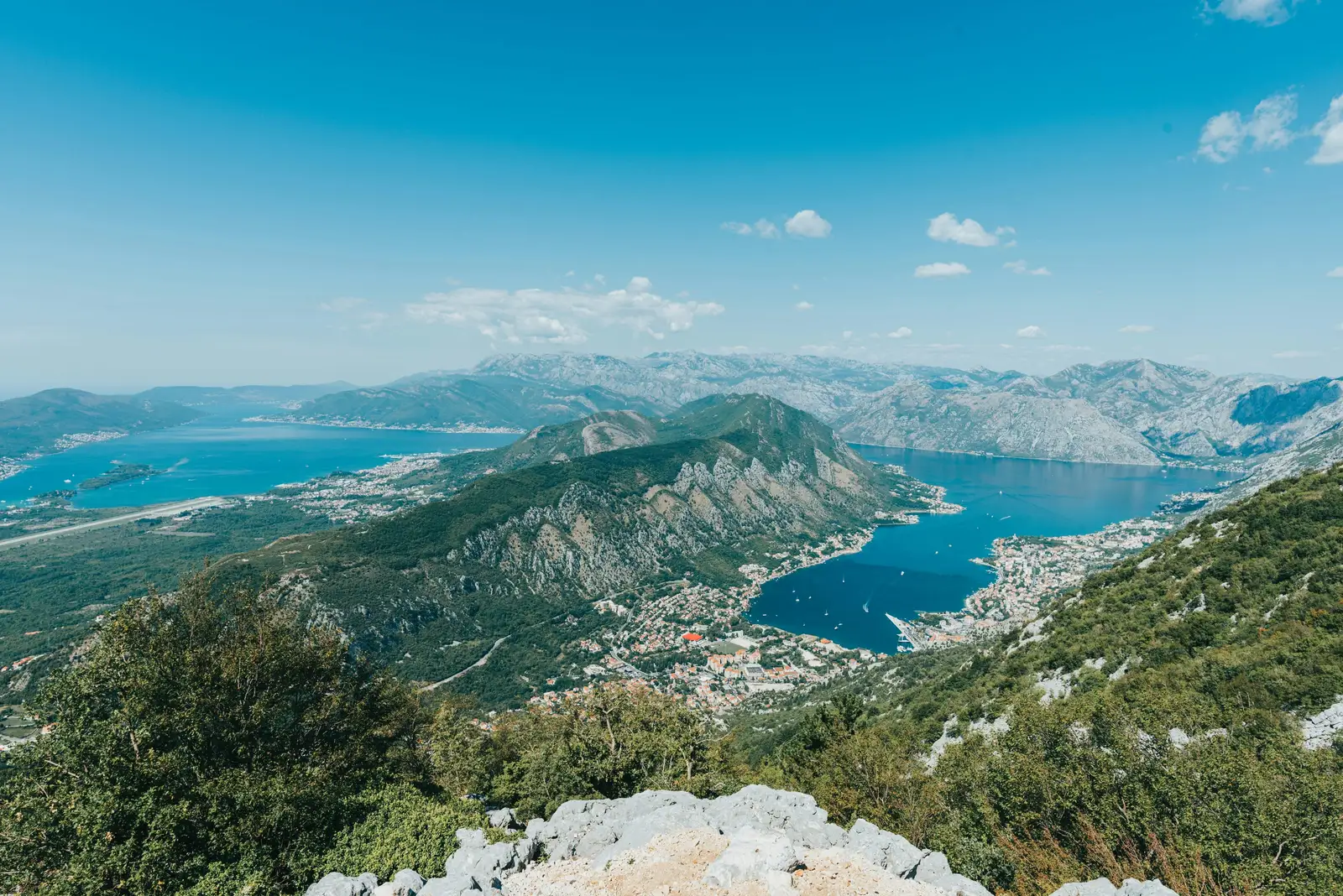
The Bay of Kotor is the reason people come. A drowned river canyon rather than a fjord, though everyone calls it one, turning back on itself twice between mountains that rise straight out of the water. Perast, Kotor, Morinj and Tivat are all on it, which puts four of the eight venues here.
Herceg Novi sits at the mouth of the bay where it opens to the Adriatic, and it is the closest municipality to Dubrovnik. Portonovi, Savina Winery and Mamula island all fall under it, and a guest flying into Croatia can be at any of the three inside an hour of landing.
The Budva Riviera is the open coast south of the bay, sandier and busier, and it holds Sveti Stefan. This is where Montenegro looks least like the bay and most like the rest of the Mediterranean.
Inland and south, behind Bar and Sutomore, is where the estates are. Talici Hill is here, and so is most of what a couple wanting a private property rather than a hotel will end up looking at.
One practical note shapes every guest list. The Kamenari to Lepetane ferry crosses the Verige strait at the narrowest point of the bay in five minutes, runs every fifteen to twenty minutes and costs €5 a car, and it saves 28 kilometres and about half an hour against driving round. Whether your venue is on the ferry side or the far side changes every transfer time on the weekend.
Can You Legally Marry in Montenegro?
Yes. This is the section that separates Montenegro from most of what this site sells, and it is worth being blunt about how large a difference it is.
In France, a foreign couple cannot legally marry. The civil ceremony has to happen at a mairie and carries a residency requirement, so what happens on the day is symbolic and the legal marriage took place at home some weeks earlier. Monaco is stricter still, requiring a month’s legal residency before the banns. Everything on those pages describes a beautiful ceremony that is not, in law, the wedding.
Montenegro is the opposite. There is no residency requirement, no waiting period and no minimum stay, and the civil ceremony performed in front of your guests is the marriage.
The registrar comes to you. Montenegrin municipalities will send an authorised registrar out of the office to a hotel terrace, a garden or an island for a fee in the region of €100, against about €25 for the ceremony held at the municipal office itself. That fee is the whole mechanism, and it is why a Montenegrin wedding day has one ceremony in it rather than two.
What you need is straightforward and unforgiving about paperwork.
Passports for both of you and for your two witnesses, who must be over 18. A certificate of no impediment from each home country, which the United States handles as an affidavit sworn at the embassy. An apostille on those documents for every Hague Convention country, which is most of them. Official translation into Montenegrin.
And a court interpreter, present at every stage from the application to the ceremony itself, unless you both speak the language. This one catches people. It is not a formality you can wave through on the morning, and the registrar will not proceed without it.
Start the documents three months out. None of it is difficult and all of it is sequential, which means a certificate that arrives without its apostille in the last fortnight is a real problem rather than an inconvenience.
Planning a wedding in Montenegro?
INQUIREMusic Curfew and Noise in Montenegro
Here is the one place this page has to admit an unknown.
Montenegro regulates noise under an environmental noise law of 2011, and enforcement sits with the municipality rather than with a national authority. There is no single published hour for outdoor amplified music that holds across the country, and unlike the French prefectural arrêtés, which are public documents anyone can read, the Montenegrin position is set locally and is not reliably documented in English.
So the honest answer is that the hour depends on your opstina and your venue, and that anyone who quotes you a national figure is guessing.
What follows from that is a working method rather than a number. Get the hour from the venue in writing, at the contract stage, and confirm it against the municipality separately. A hotel’s answer about what it has allowed before is not the same as what the municipality permits, and the two diverge in August.
The structural way around the question is geography. Mamula island has no neighbours at all. Talici Hill sits on its own ground in the hills with nothing beside it. Those two remove the argument rather than winning it, which is worth more than an extra hour negotiated with a hotel that has apartments above it.
In a town, assume less. Perast is a UNESCO-protected village where people live twenty metres from the terrace, and a party that runs late there is a different proposition from one at a resort on its own peninsula.
Getting Guests to Montenegro
Two airports serve this coast and one of them is in another country.
Tivat is the one to fly into, twenty minutes from Porto Montenegro, half an hour from Kotor and about an hour from Sveti Stefan. It takes around 26 direct flights a week from the UK in season, and British Airways runs Heathrow to Tivat three times a week from mid-May through late September at about three and a half hours. For a British guest list this is the whole answer.
Dubrovnik carries the only direct route from the United States into the region, United from Newark daily through the summer. It is twenty minutes from the Croatian border and about 45 minutes from Herceg Novi, which makes it closer to Portonovi than Tivat is to Sveti Stefan.
Podgorica is Montenegro’s larger airport and the least useful for a wedding on this coast, at an hour and a half to the bay through the Sozina toll tunnel.
Then the border, which is the weakest point of a Montenegro wedding and the one thing on this page we plan around hardest.
The main crossing at Debeli Brijeg takes fifteen to thirty minutes out of season. In July and August it can run past three hours. Coaches and trucks queue in the same lanes, which means a wedding that puts 60 guests on a bus from Dubrovnik in August has built a bad afternoon into its own schedule.
There are ways through it. The smaller Vitaljina crossing takes cars and is usually quicker. Arrivals scheduled before nine in the morning or after eight at night mostly avoid the worst of it. And for the wedding day itself, boats move guests around the bay faster than roads do and are a great deal more pleasant, which is why a Montenegrin transfer plan looks like a fleet of tenders rather than a line of coaches.
Season and Weather in Montenegro
May to October, and June and September are the two months we push people toward.
July and August bring the heat, the crowds and the border queues together, and they are also when the hotels charge most and the ferry backs up. September holds the sea temperature, empties the roads and drops the prices, and the light on the bay in the second half of it is why we keep sending people there.
The bay has its own weather. Those mountains trap cloud coming off the Adriatic, and the slopes above Kotor are among the wettest places in Europe by annual rainfall, which sounds alarming until you learn that almost all of it falls between October and April. A summer wedding here sits in a dry, sheltered, warm pocket. A wedding in late October is taking a real chance, and a wedding in winter is not a thing this coast does.
Sea and mountain sit close enough together that evenings cool off fast even in August, which is a genuine kindness after a French August and something to tell guests before they pack.
Where Guests Stay in Montenegro
This is where Montenegro is easiest, and it is the direct opposite of Monaco.
There is a complete range of hotels here. Five-star at Portonovi, Regent and Perast, then a deep field of good four and three-star properties across Kotor, Tivat, Herceg Novi and Budva, and a large private rental market on top of that. A guest list of 120 does not have to be 120 rooms at one price level, which means the cost of attending your wedding is something guests can choose for themselves.
That matters more than it sounds. The single biggest complaint about a Riviera or Monaco wedding is what it costs the people you invited.
Two of the venues here sleep almost everybody. Regent has 149 rooms and Heritage Grand Perast 130, so a wedding at either can put most of a guest list under the same roof as the party and nobody drives anywhere afterwards.
The other two are the opposite. Mamula has 32 keys and Aman 58, and both are properties where the wedding party sleeps on site and the guest list sleeps ashore. On Mamula that means a boat at the end of the night, which needs a schedule and a second boat.
We hold blocks nine to twelve months out and put one guest page up with the options priced by tier, walking distance and transfer time.
We would recommend Magic Day to anyone who's planning their wedding in any part of Europe.
Magic Day Insights
The legal ceremony is the reason to be here. Most couples arrive not knowing they can actually get married in Montenegro. Once they do, the shape of the weekend changes: one ceremony instead of a registry office at home and a performance abroad, and parents who understand exactly what they are watching.
Start the paperwork at three months and treat the interpreter as compulsory. A court interpreter has to be present from application to ceremony. It is the requirement most often discovered late and it cannot be solved on the morning.
Budget for what travels in. Above a certain standard the production, the florals, the technical crew and sometimes the kitchen all come from outside the country. Price that at the start rather than discovering it at the second revision.
Boats, not coaches. The bay is a road that happens to be water. Transfers by tender are faster, better looking and often cheaper than moving the same people around the shoreline, and they make the arrival at a venue part of the day.
The border decides your arrivals day, not your wedding day. If guests fly into Dubrovnik in August, land them early or land them late. Nothing else works.
Buyouts are within reach here. Taking a whole hotel for three or four days is a normal negotiation in the Bay of Kotor at numbers that would be impossible on the Côte d’Azur. For a wedding of 100 it is often the better answer than hiring a big room.
Aman has no recent track record. The island reopened on 1 July 2026 after five years closed. We are watching it before we put a 2027 wedding on it, and we would say the same to you.
Mamula’s history belongs in the conversation. The fort was a prison camp under Italian occupation in 1942 and 1943. Tell your family yourself.
Ask about the harvest. Savina is a working winery and September is when it works.
Wedding Planner Montenegro
Magic Day has been established in Tivat at 16 Đačka since 2014. By appointment only.
Magic Day has planned weddings across 11 countries since 2008, and Montenegro is the one where the wedding is a wedding rather than a beautiful reenactment of one. That single fact changes what a planner does here.
What a venue’s hire covers in Montenegro is roughly what it covers anywhere: the room, the ground, the kitchen where there is one, and the people who run the building. What it does not cover is larger than in France, because the country is smaller. There is no deep bench of production companies to call, so a Montenegro wedding planner is assembling a supplier list across borders and taking responsibility for whether those people and their equipment arrive.
Then the legal work, which is genuinely ours. A Montenegrin civil marriage means documents from two countries, apostilles on each, sworn translations, a court interpreter booked for every appointment, and a registrar released from the municipal office to stand on a terrace at the hour you have chosen. None of it is hard and all of it is sequential, and it is the part of a Montenegro wedding that fails quietly if nobody owns it.
The rest is the country being small. Eight venues, one ferry, one border and a season that is really four months. A wedding planner in Montenegro knows which of those eight fits 140 people, which municipality answers the phone in August, and which boat captain will still be there at one in the morning.
Tell us the guest count and the month, and we will tell you which of the eight are actually available to you.
Common Questions
How much does a Montenegro wedding cost?
A Montenegro wedding runs €30,000 to €250,000 all-in for 40 guests, €60,000 to €400,000 for 80, and from €150,000 at 150. Catering is €80 to €200 a head. Montenegro is the cheapest way to put a wedding of this standard on the Adriatic, and the saving is real rather than a trade: the same guest count at Portonovi or Perast lands well under the French Riviera equivalent. Where the budget goes instead is imports, because the supplier base here is thin and production, florals and some staff travel in. Magic Day weddings in Montenegro start from €100,000.
Can you legally get married in Montenegro?
Yes, and it is the reason many couples choose it. Montenegro sets no residency requirement and no waiting period for foreign nationals, and a registrar will leave the municipal office and perform the ceremony at your venue for a fee of about €100. You need passports, a certificate of no impediment from each home country carrying an apostille, a court interpreter present at every stage, and two witnesses over 18. The civil ceremony is the marriage, it happens on the day in front of your guests, and it is recognised at home. France and Monaco both refuse a foreign couple this.
What are the best wedding venues in Montenegro?
Eight properties take a full wedding. Regent Porto Montenegro at Tivat seats 300 and One&Only Portonovi at Herceg Novi 220, which makes them the two answers to a large guest list. Talici Hill above Bar is the one private estate, taken whole. Heritage Grand Perast sits in an 18th-century palace on the water in a UNESCO town. Mamula Island is a restored fort on its own island at the mouth of the bay. Aman Sveti Stefan is the famous one and among the smallest, at about 60.
What time does music have to stop in Montenegro?
There is no single published national hour, which is the honest answer and an unusual one for this site. Montenegro regulates noise under its environmental noise law and enforcement sits with the municipality, so the hour that outdoor amplified music stops is set locally and is not reliably documented in English. Get it in writing from the venue and confirm it against the opstina before the timeline is built. A private island or a standalone estate with no neighbour is the structural way around the question rather than an argument about it.
How many guests can you have at a Montenegro wedding?
Up to about 300 seated at Regent Porto Montenegro, 250 on the lower lawn at Talici Hill and 220 at One&Only Portonovi. Below that the country narrows quickly: Heritage Grand Perast takes 120, Mamula Island 100, Savina Winery 80, and Aman Sveti Stefan and Ćatovića Mlini about 50 to 60. Montenegro is a small country with a short list, so a guest list over 150 chooses between three properties rather than forty, and that choice should be made before the invitations.
Which airport is best for a Montenegro wedding?
Tivat for UK guests and Dubrovnik for American ones. Tivat is 20 minutes from Porto Montenegro and takes around 26 direct flights a week from the UK in season, including British Airways from Heathrow three times a week through the summer. Dubrovnik carries the region's only direct US route, United from Newark daily, and sits 20 minutes from the Croatian border and about 45 minutes from Herceg Novi. Podgorica is the third option and the least useful for the coast.
When is the best time to get married in Montenegro?
June and September. The season runs May to October, and the two shoulder months give you warm water, open venues and a border you can cross in half an hour. July and August are hotter and fuller and they cost more, and the Debeli Brijeg crossing from Croatia can run over three hours at peak, which is a genuine problem if your guests are flying into Dubrovnik. Winter is not a season here: the mountains above the Bay of Kotor are among the wettest places in Europe.
Do you need a wedding planner in Montenegro?
More than in France, and for the opposite reason. In Provence the venues are many and the suppliers deep; in Montenegro the venues are eight and the supplier base is thin, so a wedding above a certain standard is assembled from Belgrade, Zagreb, Italy and further, and knowing who travels well is most of the job. Add the legal ceremony, which is genuinely available here and comes with documents, apostilles and a court interpreter, and the border, which decides your guests' arrival day.
Planning a wedding in Montenegro?
Thank you — we have it.
One of our planners will be in touch personally, usually within one working day.