
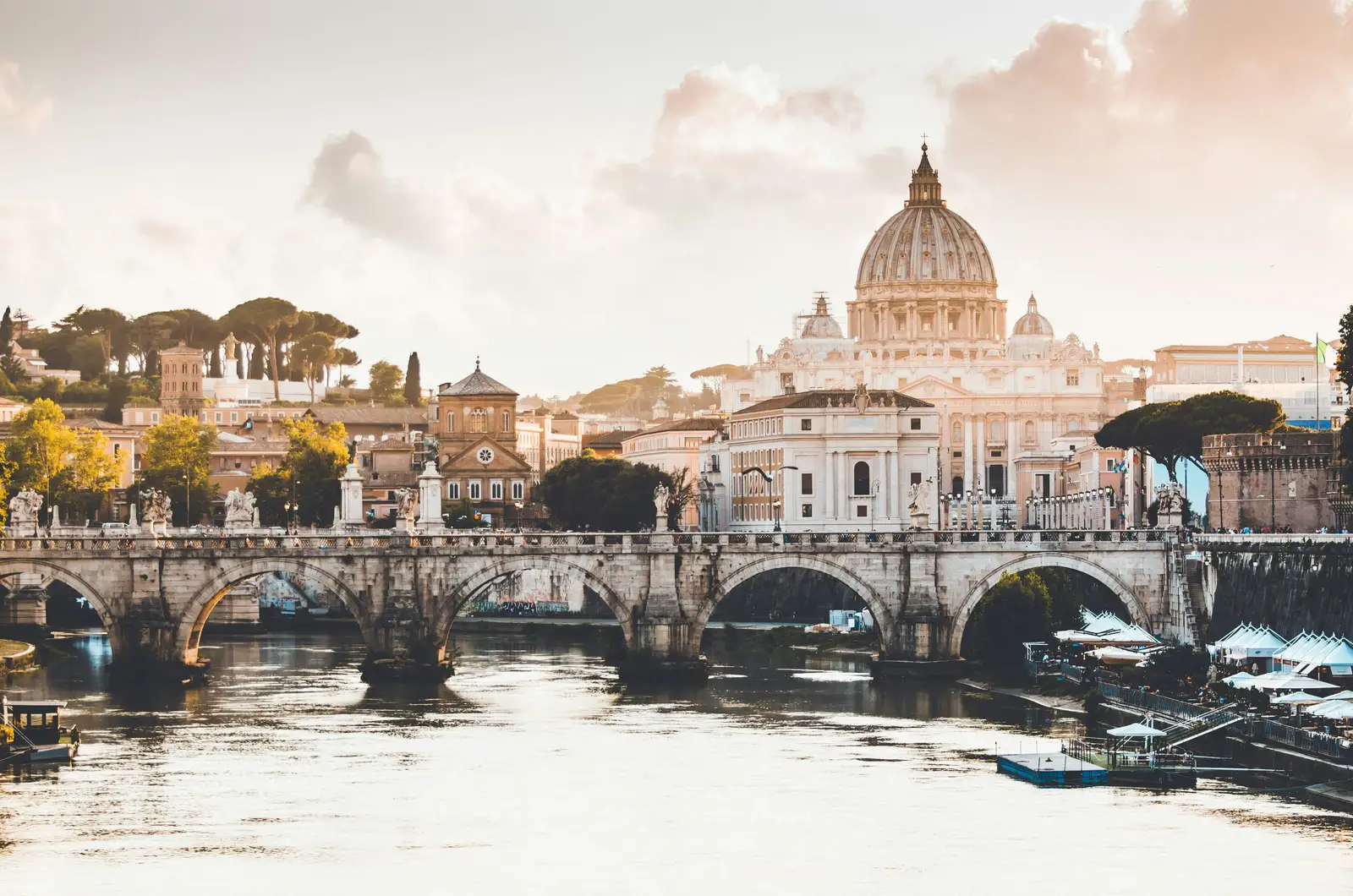
What a Rome Wedding Costs
A Rome wedding runs €50,000 to €300,000 all-in for 40 guests, €80,000 to €600,000 for 80, and from €200,000 at 150. Catering is €150 to €300 a head before drinks. Magic Day weddings in Rome start from €100,000.
That range is the widest of any city on this site, and it is not imprecision.
Rome holds a lakeside castle quoted at over a thousand guests and a hotel garden that takes eighty. Those are not the same product at different prices; they are different weddings, and a couple who has averaged two Rome quotes has a number that describes neither of them.
The useful split is city against outside it.
A wedding inside Rome is a city wedding with everything that implies: a venue on a street inside a restricted traffic zone, no yard to park a lorry in, a delivery window, and labour rather than logistics as the cost driver. What you get back is that guests need nothing. Rome has tens of thousands of hotel rooms, everything is twenty minutes from everything, and there is no transfer plan worth the name.
A wedding at Bracciano or on the coast is the opposite, and it prices like a countryside wedding: more space, more freedom, more building, and coaches at both ends of the night.
Against the rest of Italy, Rome sits below Venice and roughly level with Florence for a comparable property. What it has that neither of them does is scale, and scale here is cheaper than it is anywhere else in the country simply because the rooms exist.
Rome Wedding Venues
Seven properties, described briefly on purpose. Each is getting its own page, and two of them already out-search several destination pages in this set on their own names, so the capacity by space and the hire belong there rather than here.
Read the rooms column and notice how empty it is.
Five of these seven have no accommodation at all. In Venice or on the Italian lakes that would be the defining problem of the wedding. In Rome it barely registers, because the city has more hotel rooms than most countries and your guests can stay where they like at a price they choose, twenty minutes from anything.
Villa Miani
A villa on Monte Mario, the highest hill in Rome, with the whole city laid out below the terrace and Saint Peter’s dome in the middle of it. The Salone delle Feste seats 550, the terraces take 500 outdoors, and with garden tents the site reaches 1,800.
Villa Aurelia
A 17th-century villa on the Gianicolo, owned by the American Academy in Rome since 1909, in formal gardens looking east across the rooftops. It takes 300 outdoors and 200 inside, and has no rooms of its own.
Palazzo Brancaccio
The last aristocratic palace built in Rome, finished in 1880 near Santa Maria Maggiore, with frescoed halls and a garden behind it. The Grand Hall seats 290 and the whole palace reaches about 800 across ten rooms.
Castello Odescalchi di Bracciano
A 15th-century Orsini fortress above Lake Bracciano, forty-five minutes north of the city, still owned by the Odescalchi family. It is quoted at over a thousand guests across its courtyards and halls, and it works at 100 to 200 in the smaller rooms.
Casina Valadier
A neoclassical pavilion of 1816 on the Pincio, above Piazza del Popolo, in the Villa Borghese gardens. The Giardino dell’Aurora takes 200 for dinner and up to 500 with a stage, and the smaller Fontana terrace seats 60.
La Posta Vecchia
A 17th-century villa on the sea at Palo Laziale, built over a Roman villa and restored by J. Paul Getty as his own house, now a hotel of 21 rooms. It takes 200 across its indoor and outdoor spaces and sleeps about 45.
Villa Agrippina Gran Meliá
A 5-star hotel on the Janiculum slope near the Vatican, built on the site of Agrippina’s gardens, with 110 rooms and a pool in the grounds. Its event spaces take up to 80, which makes it the small end of this page and the only one that can house most of a wedding.
Where to Marry in Rome
Three positions, and they are further apart in practice than the map suggests.
The hills are where the views are, and the reason is simple: from inside Rome you cannot see Rome. Villa Miani on Monte Mario, Villa Aurelia on the Gianicolo and Casina Valadier on the Pincio all exist to look back down at the city, and that view is the single thing a Rome wedding can offer that no other Italian city can.
The centre is where Palazzo Brancaccio and Villa Agrippina sit, along with the hotels your guests will stay in. A wedding here is walkable, and it inherits the city’s restrictions: the traffic zone, the delivery windows and the earliest music hour of the three.
Outside the city is the other kind of wedding altogether. Castello Odescalchi at Lake Bracciano is forty-five minutes north, La Posta Vecchia is forty minutes west on the coast, and both have space, grounds and their own comune.
That last point is worth more than it appears, and the legal section explains why.
One practical note about Rome that surprises people. Traffic here is worse than the distances imply and it does not follow a rush-hour pattern you can plan around, so a transfer quoted at twenty minutes is a real forty on a Friday evening. We build in the difference rather than hoping for it.
Can You Legally Marry in Rome?
Yes, and the room is a great deal smaller than anyone expects. This is the fact that shapes a Roman wedding day and almost no venue mentions it.
Rome performs legally binding civil ceremonies in three places, and the famous one is the Sala Rossa in the Campidoglio, the Michelangelo-designed complex on the Capitoline Hill. It is a formal room hung with red damask, it is in the seat of Rome’s city government, and it seats twenty people, with about seventy standing.
The other two are the Caracalla hall beside the ancient baths and Villa Lais.
The Campidoglio runs Friday, Saturday and Sunday mornings with some afternoon slots, which is a narrow window against Florence’s two Thursdays a month but a much smaller room than Florence’s 240.
So the Roman shape is fixed by that number. The legal ceremony is a small private event with parents and witnesses on a weekend morning, and the wedding everybody attends is a symbolic ceremony at the venue afterwards. That is the same arrangement as Venice and France, arrived at here because of a room’s dimensions rather than a rule about residency.
Now the part worth asking about. Bracciano and Ladispoli are not Rome.
Castello Odescalchi sits in the comune of Bracciano and La Posta Vecchia in Ladispoli, and each comune sets its own position on where a civil ceremony may be performed. Many Lazio comuni will marry couples at approved historic venues in their own territory. Whether these two do is the first question to put to them, because if the answer is yes it removes the split day entirely and everybody watches the wedding that legally is one.
We would ask that before comparing prices, because it is worth more than most of what a venue quote contains.
The paperwork is the standard Italian set either way: a nulla osta from your own embassy stating there is no impediment, passports, birth certificates, sworn translations into Italian, and apostilles where documents came from outside the EU. Allow three to six months, and an interpreter is required.
Planning a wedding in Rome?
INQUIREMusic Curfew and Noise in Rome
Set by the comune, and Rome city is one of the stricter ones in Italy for the obvious reason that three million people live in it.
The venues in the centre and on the hills all sit in residential districts. Villa Miani and Villa Aurelia have gardens and views, and they also have apartment blocks below them, and sound travelling downhill over a city carries further than sound crossing a field. Enforcement is real and the hour is earlier than the Tuscan countryside allows.
That is the cost of the view, and it is worth naming before a couple falls for a terrace.
Bracciano and Ladispoli are separate comuni with their own rules, and both properties stand in their own grounds rather than among neighbours. A castle above a lake and a villa on a private stretch of coast are not in the same conversation as a hill above a residential quarter.
So for a wedding that wants to run late, the geography and the licence point the same way, which is unusual and convenient.
Ask for the hour in writing at contract stage, and ask separately whether live music and amplified sound carry different limits. In Rome they frequently do.
Getting Guests to Rome
This is the easiest arrival on the Italian side of this site.
Fiumicino is the largest airport in Italy, with direct flights from a long list of US cities and dense European connections in every direction. It is about thirty minutes from the centre, and twenty from La Posta Vecchia on the coast, which makes the coastal venue closer to the airport than most of the city is.
For an American guest list Rome sits alongside Milan and Venice as one of the three straightforward answers in Italy, and ahead of both on the number of cities served.
Ciampino takes low-cost European traffic and sits south-east of the city, useful for guests coming from within Europe on a budget.
Once here, Rome is a city with public transport, taxis and hotels at every level, so guests can be left to themselves in a way they cannot on the lakes or in Venice.
The exception is the traffic, which is genuinely bad and unpredictable. A coach from a central hotel up to Monte Mario is not a long distance and it is not a short journey either on a Friday evening. For a wedding at Bracciano or on the coast, plan on the drive taking longer than the map says in both directions and put the buffer in the schedule rather than in the hope.
Season, Weather and August in Rome
April to October, and Rome’s August deserves its own warning.
The city is hot in a way that is hard to convey. Temperatures routinely pass 35 degrees, the stone holds heat well past midnight, and there is no sea breeze to speak of even though the coast is thirty minutes away. That alone would make August difficult.
What makes it worse is that Rome closes.
Around Ferragosto in mid-August, Romans leave the city in numbers, and a large share of the restaurants, bars and small suppliers shut for two or three weeks. The city that remains is visitors and heat, and the network a wedding depends on is on holiday. It can be worked around and it is not worth working around.
May, June and late September are the months we push. Late September in particular gives you warm evenings, a working city and the light that makes the stone look like it is lit from inside.
April and October are both beautiful and both carry real rain risk, which in Rome arrives as short heavy storms rather than steady rain. The indoor capacity of your venue matters at those edges: Palazzo Brancaccio and Villa Miani both have real rooms, and a garden venue on the Pincio in October is a gamble with a marquee attached.
Where Guests Stay in Rome
Five of the seven venues on this page have no rooms, and it hardly matters.
Rome has hotel stock at a scale nothing else in Italy approaches, at every price point, concentrated in a centre that is walkable and served by taxis at all hours. A guest list of 150 can be spread across five hotels at five price levels within fifteen minutes of each other, and every guest can choose what they spend rather than being told.
That is a real advantage over almost every destination on this site, and it is worth setting against Rome’s higher venue costs.
Two venues do sleep people. Villa Agrippina has 110 rooms, which is enough to put a whole wedding under one roof near the Vatican, and La Posta Vecchia has 21 sleeping about 45, which covers the wedding party and immediate family with the rest along the coast or back in the city.
Castello Odescalchi is the one to plan carefully. Forty-five minutes north with no accommodation and a thousand-guest capacity means a large wedding needs either coaches in both directions or a block of rooms in Bracciano town, which is small.
We take the venue’s rooms where they exist, block three hotels in the centre at different tiers, and publish one guest page with journey times that account for Roman traffic rather than for Roman distances.
Magic Day Insights
The room the city marries you in seats twenty. Plan the legal ceremony as a small separate event on a Friday, Saturday or Sunday morning, and design the day everyone attends around it.
Ask Bracciano and Ladispoli whether they will marry you at the venue. They are separate comuni from Rome, and a yes removes the split day entirely. It is the highest-value question on this page and it is free to ask.
From inside Rome you cannot see Rome. If the view is what you want, you are choosing a hill, and you are choosing the earlier music hour that comes with a residential hillside.
Rome’s scale is genuinely cheap. A thousand-guest castle and a 550-seat villa exist here and nowhere else in Italy at this level. For a large wedding, Rome is the answer rather than a compromise.
Beds are not the problem here. Five of seven venues have no rooms and the city has tens of thousands. Spend the planning effort on transport instead.
Budget Roman traffic, not Roman distances. Twenty minutes on a map is forty on a Friday. Every transfer on the day needs the real number.
Do not do August. It is not only the heat. The city empties, the restaurants close and half your supplier list is away.
October has rooms, not gardens. The rain arrives as storms. If the date is late, choose a venue with a hall you would actually want to be in.
Wedding Planner Rome
Magic Day has been established in Rome at 5 Via dei Luceri since 2011. By appointment only.
Magic Day has planned weddings across 11 countries since 2008, and Rome is the city where the smallest room decides the largest wedding. A wedding planner in Rome starts with the Sala Rossa calendar, because a legal ceremony seating twenty on a weekend morning is not a detail to arrange later; it is the fixed point everything else is built around.
What a venue’s hire covers here divides the usual way. The hotels come with a kitchen and a staff. The palaces and the villas come with a room, a garden and a permission, and everything else arrives through a door on a street inside a restricted traffic zone, on a permit, carried by hand because there is no back-of-house.
Then the question this page exists to raise, which is whether you need the split day at all. Bracciano and Ladispoli are their own comuni, they may well marry you at the venue, and nobody asks them. A Rome wedding planner who asks that question first is worth the fee before doing anything else.
And then the ordinary Italian administration, sequential as always: a nulla osta from your embassy, sworn translations, apostilles, an interpreter, and three to six months of it with each step waiting on the one before.
Tell us the guest count and the month, and we will tell you whether your wedding belongs on a hill, in a palace or outside the city entirely. In Rome those are three different weddings and the choice is made early.
Common Questions
How much does a Rome wedding cost?
A Rome wedding runs €50,000 to €300,000 all-in for 40 guests, €80,000 to €600,000 for 80, and from €200,000 at 150. Catering is €150 to €300 a head. The range is wider than any other Italian city on this site because the venues are not comparable products: a castle at Bracciano that takes a thousand people and a hotel garden that takes eighty are different weddings, and averaging them describes neither. Magic Day weddings in Rome start from €100,000.
Can you legally get married in Rome?
Yes, at the comune, and the room is smaller than couples expect. Rome performs legally binding civil ceremonies at the Sala Rossa in the Campidoglio, which seats 20 with about 70 standing, and at the Caracalla hall and Villa Lais. The Campidoglio runs Friday, Saturday and Sunday mornings with some afternoon slots. You need a nulla osta from your embassy, sworn translations and apostilles. Most couples marry there with close family and hold a symbolic ceremony at the venue.
What are the best wedding venues in Rome?
Seven we argue for. Villa Miani on Monte Mario seats 550 and is the largest wedding room in Italy on this site. Villa Aurelia on the Gianicolo takes 300 in gardens above the city, and Palazzo Brancaccio 290 in the centre. Outside the city, Castello Odescalchi at Lake Bracciano holds over a thousand and La Posta Vecchia is a Getty villa on the coast with 21 rooms.
What time does music have to stop at a Rome wedding?
It is set by the comune, and Rome city is strict. The venues in the centre and on the hills sit in a dense residential capital where enforcement is real, so expect an earlier hour than the Italian countryside allows. The two properties outside the city are in different comuni entirely: Bracciano and Ladispoli set their own hours and both stand in their own grounds. Get the hour in writing before the deposit.
How many guests can you have at a Rome wedding?
More than anywhere else in Italy. Castello Odescalchi at Bracciano is quoted at over a thousand across its inside and outside spaces, and Villa Miani seats 550 in the Salone delle Feste and reaches 1,800 with garden tents. Palazzo Brancaccio takes about 800 across the whole palace. The constraint is at the other end of the day: the Sala Rossa where the city marries you seats 20.
Which airport is best for a Rome wedding?
Fiumicino, which is the largest airport in Italy and carries direct flights from a long list of US cities as well as dense European connections. It is about 30 minutes from the centre and 20 from the coast at Palo Laziale. Ciampino handles low-cost European traffic and is closer to the south of the city. For an American guest list Rome is one of the three easiest destinations on this site.
When is the best time to get married in Rome?
May, June and late September. The season runs April to October, and August is the month to avoid for a reason beyond heat: Rome closes. Romans leave for Ferragosto, restaurants shut for two or three weeks, and the city belongs to visitors in temperatures that regularly pass 35 degrees. April and October are lovely and carry real rain risk.
Do you need a wedding planner in Rome?
Yes, and the first thing a planner earns here is the calendar. The Sala Rossa runs Friday to Sunday mornings and seats 20, so the legal ceremony is a separate event that has to be booked and built around. Add venues in a restricted traffic zone with no back-of-house, a nulla osta that takes three to six months, and two properties outside the city under different comuni. Magic Day has planned weddings across 11 countries since 2008.
Planning a wedding in Rome?
Thank you — we have it.
One of our planners will be in touch personally, usually within one working day.