
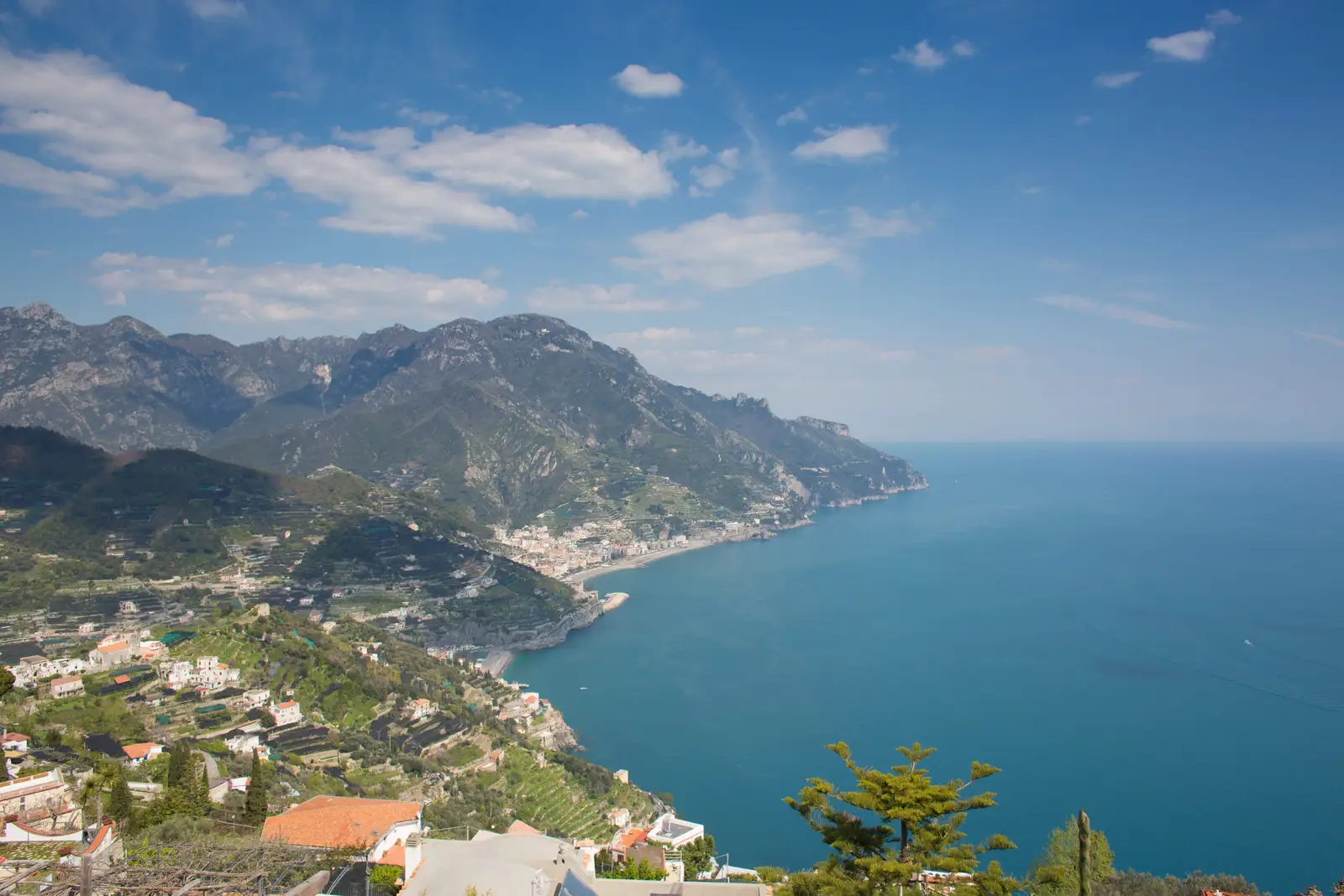
What an Amalfi Coast Wedding Costs
An Amalfi Coast wedding runs €40,000 to €2 million all-in: €40,000 to €200,000 for 40 guests, €100,000 to €600,000 for 80, and from €250,000 at 150. Venue hire is €8,000 to €200,000 of that, catering another €350 a head on average before drinks. Magic Day weddings on the coast start from €100,000.
This is the most expensive coast in Italy to marry on, and the reason is not glamour. It is gravity.
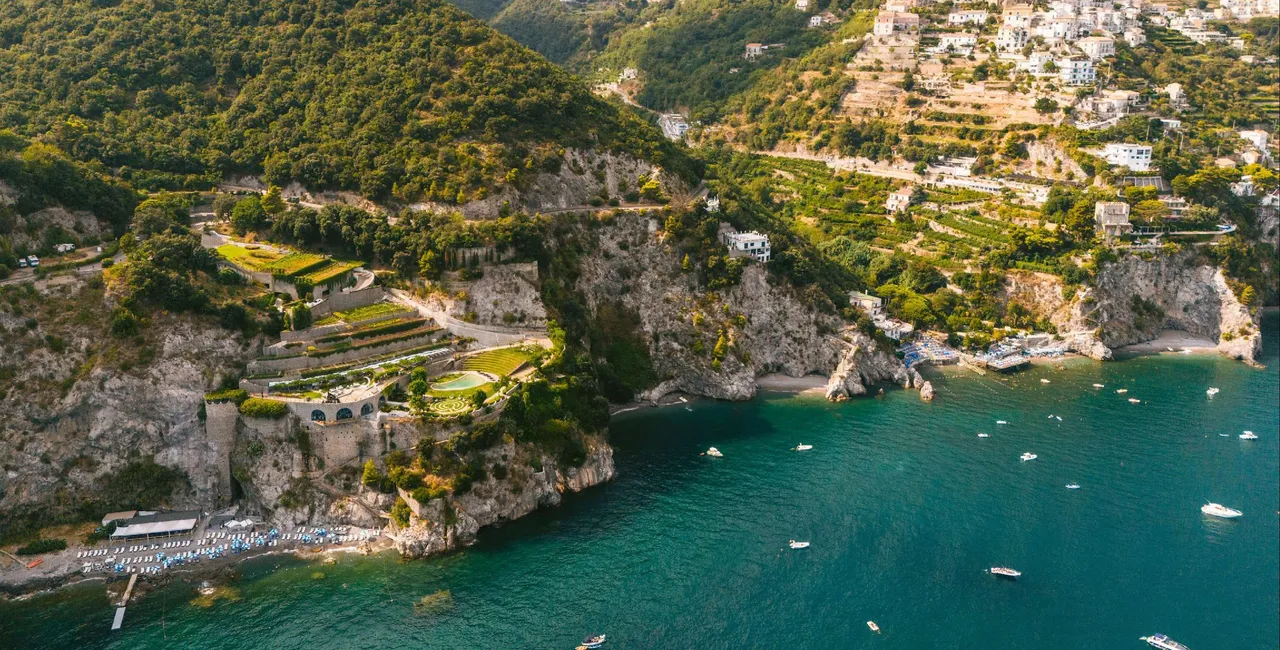
There is one road. It was cut into the cliff in the 1830s, it is a single lane in each direction with a wall on one side and a drop on the other, and there is nowhere along it to park a lorry, store a marquee or turn a vehicle around. Most of the venues sit below the road and are reached down flights of steps, or from the water.
So everything is carried.
Chairs, tables, glassware, flowers, kitchen equipment and cases of wine come down by hand or by a small service lift, in relays, by people paid to do it. That labour is invisible in a venue quotation and it is a real fraction of the total, and it is why the same wedding costs more here than an hour north in Sorrento.
The second cost is time. A supplier coming from Naples spends a large part of the day in traffic on the coast road, and that is priced in.
What the coast gives back is the thing nobody can build anywhere else. Terraced lemon groves, a monastery cloister above the water, and a sea that changes colour through the afternoon. Couples who understand what they are paying for tend to be happy with it, and couples who arrive expecting Tuscan value are not.
Two of the Weddings We Have Planned Here
40 guests at the Anantara Convento, €110,000. The welcome dinner was at Donna Stella, a pizzeria in a lemon garden above the streets of Amalfi, and on the Sunday the whole party took a boat from Amalfi to Capri and back. For forty guests that sits in the middle of the range above. The boat is the decision we would repeat: there is no better way to spend an extra day with the people closest to you.
130 guests at Giardini del Fuenti, €350,000. At 130, the Fuenti was the answer, and we built the whole weekend at the eastern end of the coast. The welcome dinner was at a traditional restaurant in Salerno, the guests stayed at Raito and in several four-star hotels in Salerno, and the day after the wedding there was a trip to Pompeii, with lunch there. The bride arrived by boat, from the sea rather than down the road. The whole weekend never touched the slow middle of the coast road.
Amalfi Coast Wedding Venues
Six properties: five hotels in Amalfi town and along the coast either side of it, and one garden at Vietri sul Mare, where the coast begins. Ravello and Positano are deliberately not here: each has its own page, and their venues belong there rather than being borrowed by this one.
Read the capacities before anything else.
The largest hotel here seats 100 for dinner. The Anantara Convento stops at 60, Borgo Santandrea at 60 unless you take the whole hotel, Monastero Santa Rosa at 35, and Casa Angelina now takes elopements of six at most. On fifty kilometres of the most famous coastline in Italy, that is the fact most couples do not know before they fall in love with a photograph.
The cause is geography rather than policy. There is no flat ground between the mountains and the sea, so every hotel here is a set of terraces cut into a cliff, and a terrace has the dimensions it has. The one venue that seats several hundred is a garden at the eastern end, on land a demolished hotel left behind.
Hotel Santa Caterina
A cliffside hotel just west of Amalfi town, owned by the same family since 1904, with lemon terraces hung with bougainvillea, a lift down through the rock to a seawater pool and 66 rooms. Dinner is in the Al Mare restaurant for up to 100, the botanic garden takes 70 for a symbolic ceremony, and the music stops at 11:45pm.
Our verdict. We would choose it for the gardens over the sea, for a wedding of fewer than 70, as long as you are comfortable finishing the party at a quarter to midnight.
Read the full Hotel Santa Caterina wedding guide for its spaces, its rooms and what a wedding there costs.
Anantara Convento di Amalfi Grand Hotel
A convent of 1212 on a cliff shelf above Amalfi, later home to Capuchin friars, reached by lift from the road, with an arcaded cloister and the sea two hundred feet below. Weddings stop at 60 guests, with a chapel and a cloister for the ceremony and dinner along the Monk’s Walk on the cliff edge.
Our verdict. The balance on this coast: a space as special as any here, with no buyout needed. We would choose it for a wedding of up to 60 that is happy to end the party at midnight.
Read the full Anantara Convento di Amalfi wedding guide for its spaces, its rooms and what a wedding there costs.
Borgo Santandrea
A 1960s cliff hotel between Amalfi and Conca dei Marini, reopened in 2022 after a full restoration, with 52 rooms and one of the few private beaches on this coast. Up to 60 guests celebrate at the beach club without taking the hotel; beyond that the whole hotel is taken, for up to 100.
Our verdict. For a smaller wedding that wants the whole hotel to itself, with a large budget to spend on it.
Read the full Borgo Santandrea wedding guide for the beach, the rooms and what a buy-out wedding there costs.
Monastero Santa Rosa
A 17th-century convent at Conca dei Marini, restored over years into a twenty-room hotel with terraced gardens on five levels above the sea. Weddings are taken only on a full buyout of the property, for up to 35 guests seated on the main terrace.
Our verdict. The same case as Borgo Santandrea, a small wedding with the whole place to itself, on a more reasonable budget.
Casa Angelina
A white modernist hotel at Praiano, deliberately spare against a coast that is anything but, with 36 rooms, contemporary art and a lift and steps down to its own beach club. Since 2024 it has taken elopements only, six people at most.
Our verdict. Beautiful, and only for the tiniest of weddings.
Giardini del Fuenti
Terraced gardens on the cliff between Cetara and Vietri sul Mare, where the Hotel Fuenti stood until 1999, the first building in Italy to be called an ecomostro. The gardens that replaced it are the one venue on this coast built for numbers: 250 for a civil or symbolic ceremony, 300 for dinner and 400 in the arena, with a beach club below, a Michelin-starred kitchen and no rooms of its own.
Our verdict. The venue for a larger wedding that wants a later night than anywhere else on this page: the music runs until 1am, and the night ends down in its grotto.
Read the full Giardini del Fuenti wedding guide for its spaces, where guests stay and what a wedding there costs.
Venue guides on the Amalfi Coast
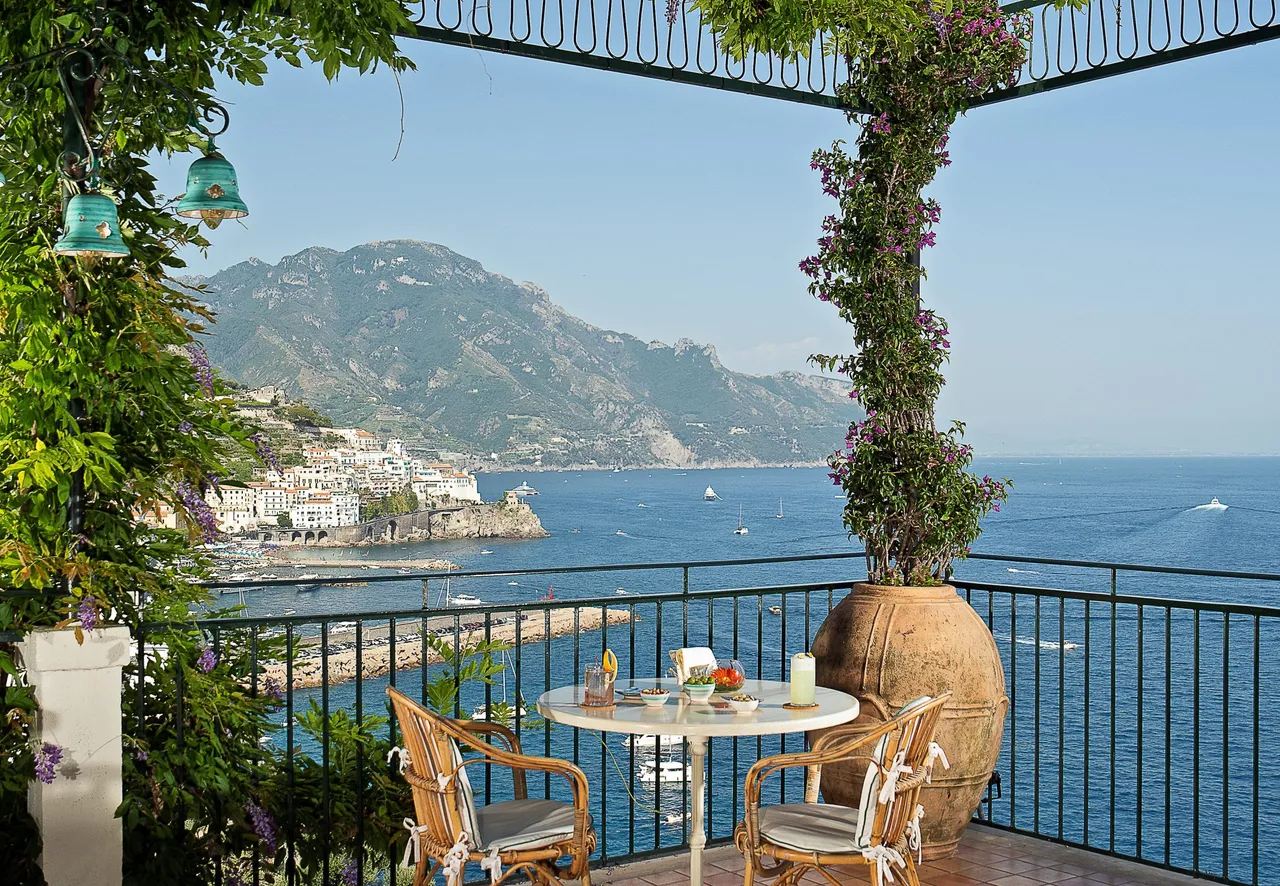
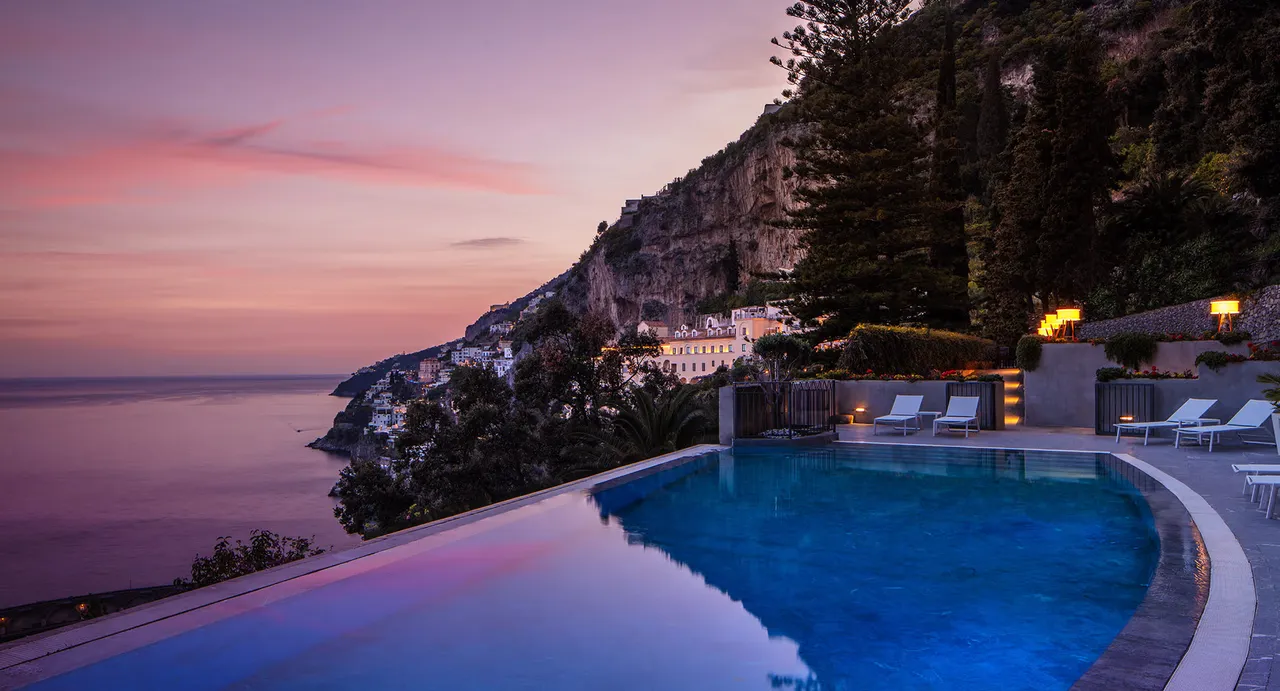
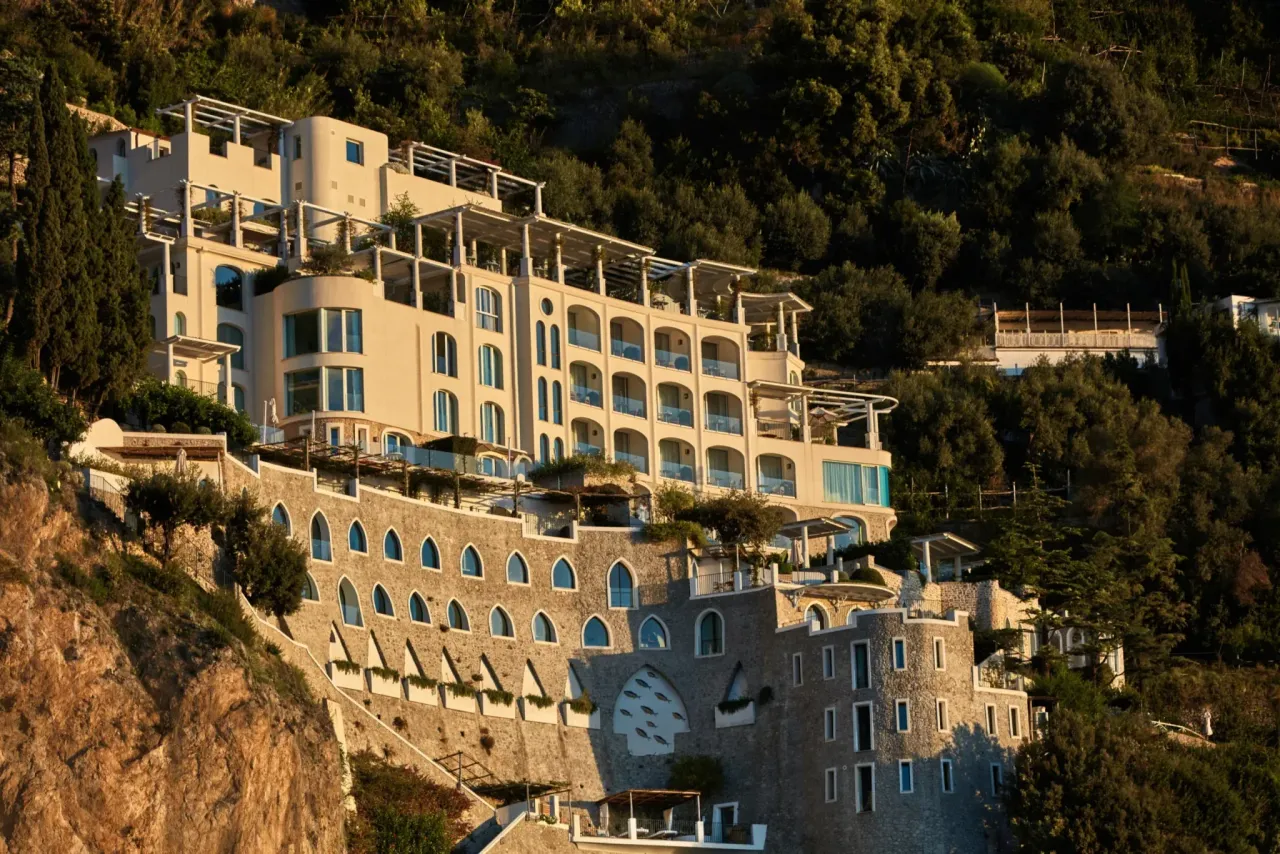
Where to Marry on the Amalfi Coast
Fifty kilometres of one road along the southern side of the Sorrentine Peninsula, and where you sit on it decides the wedding. The coast has been a UNESCO World Heritage Site since 1997, and the landscape rules that protect it are part of why almost nothing new is built here: the venues are, nearly without exception, buildings that were already standing.
Amalfi town is the middle and the practical centre. Three of these five venues are here or immediately beside it, the ferry stops here, and it is the only town on the coast with anything resembling infrastructure. It is also a working town of five thousand people that receives a great many more in summer.
West toward Positano runs through Conca dei Marini and Praiano, where the cliffs are highest and the towns smallest. Monastero Santa Rosa is here, and so is Casa Angelina, which now takes elopements only. Both suit a wedding that wants quiet rather than a town.
East toward Salerno goes through Atrani, Minori, Maiori and Cetara to Vietri sul Mare, the ceramics town where the coast begins. It is the least visited stretch and the only part of the coast with any flat land at all. Giardini del Fuenti is here, between Cetara and Vietri, and this end is materially cheaper and closer to Salerno’s airport and station.
Positano is the western end and the picture most couples arrive holding: a vertical village stacked above a single beach, under the tiled dome of Santa Maria Assunta. It is the most glamorous address on the coast and the most crowded, and in July and August a wedding there shares every step with day visitors. Its hotels and villas, Villa Tre Ville and Hotel Marincanto among them, sit on terraces reached by stairs, and its four venues, Il San Pietro and Palazzo Murat among them, are compared in the Positano wedding guide.
Ravello sits on a ridge three hundred and fifty metres above Amalfi, and it is the quiet answer: gardens rather than beaches, the terraces of Villa Rufolo and Villa Cimbrone, cooler evenings and a summer music festival. It suits a wedding that wants the view without the crowd. Scala, the village beside it, has the ruined basilica of Sant’Eustachio, below under church weddings. Ravello’s five venues, the Caruso and Palazzo Avino among them, are compared in the Ravello wedding guide.
Capri is an hour away by boat and a different wedding altogether, an island with its own rules. Sorrento, over the ridge, is where the hotel rooms are.
One thing that governs every choice here. Most of these venues are below the road, and the road is where a coach can stop. That means guests arrive at a lay-by and then descend, by lift where there is one and by steps where there is not.
Ask about that before anything else if anyone in the party has trouble with stairs, because on this coast it is not a detail.
Amalfi Coast Wedding Villas
The other way to marry here is to take a villa: the whole house for the week, the welcome dinner on one terrace, the ceremony on another and the brunch by the pool, with nobody else on the property.
It is the most private format the coast offers, and it suits a smaller wedding that wants to stay put. Nobody drives anywhere at night, which on the SS163 is worth a great deal.
A villa comes with conditions a hotel would absorb for you. A private house needs the comune’s permission to host an event, and not every one has it; a villa that may seat sixty for dinner may not be allowed a band. There is rarely a kitchen built for a wedding, so the caterer brings one. Every chair and every plate is carried in, as everywhere on this coast, and most villas sleep far fewer people than they can seat, so the rest of the guests stay nearby.
On this stretch the example is Ca’ P’a Casa Privata at Praiano, a private house on the cliffs with gardens and its own beach below. Several of the best-known wedding villas are in Positano and belong on its page. The questions to ask of any of them are the same: is the event licence in the villa’s own name, what time does amplified music stop, and where does a kitchen for sixty go.
Can You Legally Marry on the Amalfi Coast?
Yes, and the answer varies town by town, which on a coast of many small comuni means it has to be asked precisely.
Each municipality along the coast keeps its own list of venues approved for civil ceremonies. The six venues above sit in four comuni, Amalfi, Conca dei Marini, Praiano and Vietri sul Mare, and each answers for itself. Within one town the answer still differs by venue: in Amalfi the Anantara Convento holds civil ceremonies in its cloister, while at Hotel Santa Caterina the legal ceremony happens at the town hall and the one in the garden is symbolic. Giardini del Fuenti, at Vietri, holds civil ceremonies on its Terrazza delle Rose.
So the useful question is never “can we marry on the Amalfi Coast”. It is “will this comune marry us at this venue”.
Ask it before comparing prices. A yes removes the split day entirely; a no means the legal ceremony happens at a town hall and a symbolic one at the venue, which is the arrangement most couples end up with elsewhere in Italy.
The paperwork is the standard Italian set either way: a nulla osta from your own embassy stating there is no impediment, passports, birth certificates, sworn translations into Italian, and apostilles where documents came from outside the EU. Allow three to six months, and an interpreter is required.
For American couples the embassy document is a sworn declaration, the dichiarazione giurata, made in person at a US consulate in Italy, which for this coast means Naples. It then goes to the prefecture’s legalisation office to be stamped, with a €16 revenue stamp bought at any tabacchi. Alongside it sits an atto notorio, a declaration sworn with two witnesses at an Italian consulate at home or a court in Italy. Both are valid only for a few months, so the consulate appointment usually falls in the days before the wedding rather than months ahead.
Compare Rome, where the city’s main ceremony room seats twenty and there is no alternative. A coast of small comuni that each set their own rules is more work to establish and frequently a better answer.
Planning a wedding on the Amalfi Coast?
INQUIREChurch Weddings on the Amalfi Coast
A Catholic wedding here is possible, legally binding if the civil paperwork is done alongside it, and slower to arrange than a civil one, because it runs through two dioceses.
Your own parish writes to the Archdiocese of Amalfi-Cava de’ Tirreni, naming the church and the date. With the letter go the prenuptial enquiry, completed with your priest and sealed by your bishop, the certificate from your marriage preparation course, and your baptism, communion and confirmation certificates. If one of you is not Catholic, the bishop’s permission for a mixed marriage is added. The Italian parish wants the complete file six weeks before the wedding, and assembling it at home takes months, so start as soon as the church is agreed.
Amalfi Cathedral is the church most couples mean. The Duomo di Sant’Andrea stands at the top of sixty-two steps above the piazza, and those steps are the entrance people marry here for. It takes weddings, though not over Easter or the major feasts, it keeps a working parish’s timetable, and in season the piazza below it belongs to everyone. Smaller churches in Amalfi, Sant’Antonio among them, suit a smaller ceremony.
The Anantara Convento has its own consecrated chapel, San Francesco, where Catholic weddings for up to 60 are held on any day but Sunday. The date and the documents still go through the parish of Amalfi, as for any church here.
Sant’Eustachio is the opposite of a cathedral. The ruined twelfth-century basilica built for the d’Afflitto family stands on a spur between Scala and the hamlet of Pontone, open to the sky, with the valleys falling away on every side. There is no roof and no parish, so the ceremony is symbolic, though civil ceremonies have been held there too and the comune of Scala will confirm for your date. It takes up to about a hundred, and it is reached by path, which is part of the point and something to tell your guests in advance.
Music Curfew and Noise on the Amalfi Coast
Set by the comune, and the geography here works against you rather than for you.
These towns are built vertically into ravines. Houses stand directly above and below every venue, often within a few metres, and sound travels up a cliff face far better than it travels across a field. A terrace that feels private because nobody is beside you is overlooked by forty windows above.
So the hours on this coast are not generous, and they are enforced by neighbours rather than by patrols. At the venues on this page they run from 11:45pm at Hotel Santa Caterina, through midnight at the Anantara Convento, Borgo Santandrea and Monastero Santa Rosa, to 1am at Giardini del Fuenti, where the night ends in its grotto bar.
The properties in a stronger position are the ones with their own stretch below the road and nothing above them: Borgo Santandrea on its beach, Monastero Santa Rosa on its own terraces at Conca, Giardini del Fuenti alone on the cliff between Cetara and Vietri. A venue in the middle of Amalfi town is the opposite case.
Ask for the hour in writing at contract stage, confirm the comune rather than the postal town, and ask separately whether live music and amplified sound are treated differently.
Then plan the evening around the answer rather than hoping to negotiate it later. On this coast the answer does not move.
Getting Guests to the Amalfi Coast
The arrival is the hardest part of an Amalfi Coast destination wedding, and it should be designed rather than assumed.
Naples Capodichino is the airport, with dense European connections, about an hour and a half to two hours from Amalfi depending on traffic and where on the coast you are heading. Salerno is closer to the eastern end and useful for Maiori, Minori and Vietri sul Mare. Giardini del Fuenti, near the motorway at Vietri, is under an hour from Naples airport and twenty minutes from Salerno’s, and its guests never drive the slow middle of the coast.
For American guests, Rome Fiumicino is the larger airport at roughly three and a half hours by road, and connecting through Rome or Milan into Naples is usually the better answer than driving the whole way.
Then the last stretch, which is the problem. The SS163 is one lane each way, it carries every vehicle on the coast, and large coaches are restricted on parts of it. In July and August a journey that takes fifty minutes in April takes two hours.
The alternative is the water, and it is a good one. Ferries run in season from Naples, Sorrento and Salerno into Amalfi and Positano, and private boat transfer is faster, more comfortable and considerably more pleasant than the road. For a wedding based in Amalfi town, moving guests by sea is often the right plan rather than the extravagant one.
Once here, distances are short and slow. Amalfi to Praiano is fifteen minutes without traffic and forty with it, and there is no way around.
Season, Weather and the Road
April to October, and the case against high summer here is the road rather than the temperature.
The coast is comfortable in July and August by Italian standards, because it faces the sea and the cliffs give shade for part of the day. What it cannot do is absorb traffic. The SS163 in August carries day visitors, delivery vehicles, buses and everybody’s wedding suppliers on the same single lane, and the whole coast slows to a crawl.
That is a guest experience problem and a supplier problem at once.
June and September are the months we push. Warm sea, a road that works, and hotels that will still negotiate. Late September in particular gives you an empty road and a sea still warm enough to swim in.
April and October are lovely and carry real rain risk, and here rain matters more than elsewhere because so much of a wedding happens on open terraces. Ask what the wet-weather room actually is at every venue on this page: several have one that is genuinely good and several have one that is a restaurant with the tables pushed back.
Outside those months the coast largely closes. Most hotels, beach clubs and seaside restaurants shut from early November until late March or Easter, Positano almost entirely, and Hotel Santa Caterina opens from mid-March to October. A winter wedding is possible in Amalfi or Ravello with a hotel that stays open, and it is a quieter, different coast.
Book early for the months that work. For a Saturday in June or September, the venue wants confirming twelve to eighteen months ahead, and sooner still at the largest of them, because there are so few. The rooms follow twelve months out.
Where Guests Stay on the Amalfi Coast
Five of the six venues here are hotels, which in this set is unusual and on this coast is close to essential.
The reason is the road. Moving a hundred guests from a hotel in one town to a venue in another, at night, on the SS163, is the thing to design out of a wedding rather than plan around. A wedding where most people sleep where they celebrate removes the single worst part of the coast.
The four that take more than a handful of guests hold 66, 52, 52 and 20 rooms between them, so a wedding of 60 to 80 can be housed almost entirely at one address. Giardini del Fuenti has none, and a wedding there books the hotels at Vietri, Cetara and Raito, or in Salerno.
Beyond that, the coast’s stock is small, expensive and booked far ahead, concentrated in Amalfi, Praiano, Maiori and Vietri sul Mare for the towns on this page. Maiori and Minori at the eastern end are the value option and materially cheaper, at the cost of twenty minutes on the road.
The honest alternative worth raising early is Sorrento, forty minutes over the ridge, which has several times the hotel capacity at every price and roads that work. For a large guest list it is sometimes the difference between a wedding that runs well and one that spends its budget on transport.
We hold blocks twelve months out here, weight them toward the venue’s own rooms, and publish one guest page with journey times by boat as well as by road.
Amalfi Coast Destination Wedding
An Amalfi Coast destination wedding is a weekend rather than a day. Guests who fly in stay several nights, and the days either side of the wedding are part of what they came for. The coast makes that easy, with one rule: plan around the water rather than the road.
A day on a boat. A private boat along the coast, stopping to swim below the cliffs and for lunch at a restaurant reached only from the sea, is the best day this coast gives a group. Capri, an hour away, makes the longer version.
The Path of the Gods. The Sentiero degli Dei runs high above Positano from Bomerano to Nocelle, about three hours on foot with the whole coast below. It suits the guests who want a morning to themselves.
Lemons, pasta and wine. A lunch in a lemon grove, a cooking class, or an afternoon with a winemaker in Furore or Tramonti gives the weekend something to taste.
Pompeii and Herculaneum. An hour and a half by road, and for a guest who has never seen them, the part of the trip they will describe first.
Ravello in summer. The Ravello Festival puts concerts in the gardens of Villa Rufolo, on a stage above the sea, and a performance there is a welcome evening nobody else is offering.
For the welcome dinner we favour a terrace in the venue’s own town, so nobody is on the road the night before the wedding. For the farewell, a long lunch by the water and a boat back.
Lemons, Limoncello and the Amalfi Coast Table
The coast has its own kitchen, and a wedding menu here should taste of it.
Lemons first. The sfusato amalfitano, long, knobbly and sweet enough to eat in slices, grows on the terraces above every town and carries its own protected name. It goes into everything from risotto to the delizia al limone, a lemon-cream sponge dome that makes a better wedding dessert than most cakes, and into limoncello, which arrives ice-cold at the end of the night whether anyone ordered it or not.
From the sea. Colatura di alici, the amber anchovy sauce made at Cetara, at the eastern end of the coast, since Roman times, stirred through spaghetti. Scialatielli, the coast’s thick fresh pasta, with clams. Whatever came off the boats that morning.
The sweets have a local story. The sfogliatella Santa Rosa was first made by the nuns of the convent at Conca dei Marini that is now Monastero Santa Rosa, one of the venues above.
Wine comes from terraces as steep as the lemons: the Costa d’Amalfi appellation, with Furore, Ravello and Tramonti as its three sub-zones, and some of the oldest vines in Italy at Tramonti.
The traditions travel well. Sugared almonds, confetti, in fives for the guests. A mandolin at the aperitivo. And a tarantella once dinner is over, usually started by the Italian guests and finished by everyone.
Magic Day Insights
Know the ceiling before you fall for a photograph. The largest hotel on this page seats 100 and the others stop at 60 or below. A guest list of 150 has one real option on this stretch, Giardini del Fuenti, and hearing that in month one is worth more than any other advice here.
Everything is carried. No parking, no back-of-house, and most venues below the road. That labour is real, it is not in the venue quote, and it is why this coast costs what it does.
Move people by boat. Ferries and private transfers beat the SS163 on time, comfort and photographs, and in August they beat it by a lot.
Ask which comune, then ask that comune. Six venues here sit in four municipalities, each with its own noise hour and its own approved ceremony venues. The postal address is not the answer.
Ask what the wet-weather room really is. So much happens on open terraces here that the indoor fallback decides an April or October wedding, and the quality of it varies enormously.
Check the steps. Most venues are reached by lift or by flights of stairs from a lay-by on the road. For any guest with limited mobility this is the first question, not a footnote.
The eastern end is the value. Maiori, Minori and Atrani are cheaper, quieter and closer to Salerno, and twenty minutes further from the postcard. It is also where the one large venue is, at Vietri sul Mare.
Sorrento is the honest alternative. Over the ridge, forty minutes, with real hotel capacity and roads that work. For 150 guests it is frequently the better wedding, and saying so early is part of the job.
Amalfi Coast Wedding Planner
Magic Day has been established on the Amalfi Coast since 2015.
Magic Day has planned weddings across 11 countries since 2008, and the Amalfi Coast is the one where the logistics are the craft. Anybody can find a beautiful terrace here. Getting a hundred people, a kitchen and a band onto it, on a single-lane road above a cliff, is the work.
What a venue’s hire covers on this coast is the terrace, the view and usually the kitchen, since almost everything here is a hotel. What sits outside it is the getting there. There is no parking, no storage and no service road, so deliveries come in relays, down steps or by lift or by boat, and the build takes longer than it would anywhere else in Italy. A wedding planner on this coast is running a hand-carried supply line for two days.
Then the constraints that are specific rather than general. A ceiling of about 100 guests at the hotels, which shapes the guest list rather than the seating plan. Four comuni with four sets of answers on noise and ceremonies, and venues that answer differently inside the same one.
A road that doubles its journey times for two months of the year, and a wet-weather plan that has to be real, because at most venues there is nowhere to put a marquee.
And then the Italian administration, sequential as ever: a nulla osta from your embassy, sworn translations, apostilles, an interpreter, and three to six months of it.
Tell us the guest count first, before the month and before the venue. On this coast that number decides whether the wedding you are imagining can happen here at all, and we would rather say so in the first conversation than the fourth.
Common Questions
How much does an Amalfi Coast wedding cost?
An Amalfi Coast wedding runs €40,000 to €2 million all-in: €40,000 to €200,000 for 40 guests, €100,000 to €600,000 for 80, and from €250,000 at 150. Venue hire is €8,000 to €200,000 of that and catering another €350 a head on average. Magic Day weddings on the coast start from €100,000. This is the most expensive stretch of coast in Italy to marry on, and the reason is that nothing can be delivered easily: one road, no parking, no storage, and everything carried down steps by hand.
How many guests can you have at an Amalfi Coast wedding?
Fewer than most couples expect. Among the hotels, Hotel Santa Caterina seats 100, the Anantara Convento and Borgo Santandrea 60, Monastero Santa Rosa 35 and Casa Angelina six, and Borgo Santandrea goes past 60 only if the whole hotel is taken. There is no flat ground on this coast, so every hotel is a set of terraces cut into a cliff. The exception is Giardini del Fuenti at Vietri sul Mare, which takes 300 and is the one real answer here for a wedding of 150.
What are the best wedding venues on the Amalfi Coast?
In Amalfi town, the Anantara Convento is a 13th-century convent, later Capuchin, with a cloister above the sea, and Hotel Santa Caterina has been in the same family for more than a century. Borgo Santandrea sits below the road with its own beach. Along the coast, Monastero Santa Rosa is a 17th-century convent at Conca dei Marini, taken whole for up to 35, and Casa Angelina at Praiano takes elopements only. Giardini del Fuenti at Vietri sul Mare is a garden on the site of a demolished hotel and the one venue here for a large wedding.
What does an Amalfi Coast destination wedding look like?
A weekend rather than a day. Guests who fly in stay several nights, so the wedding sits between a welcome dinner and a day on the water or inland: a boat to Capri and back, or a trip to Pompeii with lunch there. Plan it around the water rather than the road, and keep the welcome dinner close to the venue so nobody drives the coast road the night before the wedding.
Can we rent a villa for our Amalfi Coast wedding?
Yes, and it is the most private way to marry here: the whole house for the week and every event at one address. Ask whether the villa holds its own licence for events, what time amplified music stops, and where the caterer's kitchen goes, because a private house rarely has one built for a wedding. Most villas seat more guests than they can sleep.
Can you legally get married on the Amalfi Coast?
Yes, and the answer depends on the town and then on the venue. Every comune along the coast keeps its own list of approved civil venues, and even in Amalfi it differs: the Anantara Convento holds civil ceremonies in its cloister, while Hotel Santa Caterina's couples marry legally at the town hall. You need a nulla osta from your embassy, sworn translations and apostilles, and an interpreter. Ask the comune your venue actually sits in rather than assuming the coast has one rule.
Can a US citizen get married on the Amalfi Coast?
Yes. American couples swear a declaration, the dichiarazione giurata, in person at the US consulate in Naples, have it legalised at the prefecture, and add an atto notorio sworn with two witnesses. Both are valid only for a few months, so the consulate appointment usually falls in the days before the wedding. Passports, birth certificates with apostilles, sworn translations and an interpreter complete the set.
Can you have a church wedding on the Amalfi Coast?
Yes. A Catholic wedding runs from your home parish and bishop to the Archdiocese of Amalfi-Cava de' Tirreni, with your marriage course certificate and sacramental certificates, and it can be legally binding if the civil paperwork is done alongside it. Amalfi Cathedral, at the top of sixty-two steps, takes weddings outside Easter and the major feasts. The ruined basilica of Sant'Eustachio above Scala takes symbolic ceremonies.
What time does music have to stop at an Amalfi Coast wedding?
Between 11:45pm and 1am at the venues on this page: 11:45pm at Hotel Santa Caterina, midnight at the Anantara Convento, Borgo Santandrea and Monastero Santa Rosa, and 1am at Giardini del Fuenti, where the night ends in a bar cut into the rock. It is set by the comune and there are several along fifty kilometres of coast. The towns are dense, built vertically into ravines with houses directly above and below every venue, and sound carries up a cliff unusually well, so the hours here are not generous. A property on its own stretch below the road is in a better position than one in the middle of a town. Get the hour in writing.
Which airport is best for an Amalfi Coast wedding?
Naples Capodichino, about an hour and a half to two hours from Amalfi depending on traffic and where on the coast you are going. Salerno is closer to the eastern end. For American guests, Rome Fiumicino is the larger airport at roughly three and a half hours by road, and connecting through Rome or Milan into Naples is usually better. The last stretch is the coast road, and it is slow in every season.
When is the best time to get married on the Amalfi Coast?
June and September. The season runs April to October, and the argument against July and August is the road rather than the heat: the SS163 is one lane in each direction with no alternative, and in high summer it carries the whole coast's traffic. September gives you warm sea, a workable road and hotels that will still talk to you.
How far ahead should we book an Amalfi Coast wedding?
Twelve to eighteen months for a Saturday in June or September, and earlier for the largest venues, because there are so few. Rooms follow twelve months out. Most hotels close from early November until late March or Easter, so every wedding on this coast is competing for the same weekends between April and October.
Do you need a wedding planner on the Amalfi Coast?
Yes, and this is the least arguable case on the site. There is one road, no parking, no back-of-house at any venue, and most properties are reached down flights of steps or by boat. Every chair, every flower and every case of wine is carried by hand. Add several comuni with their own rules and a capacity ceiling most couples do not know about. Magic Day has planned weddings across 11 countries since 2008.
Planning a wedding on the Amalfi Coast?
Thank you — we have it.
One of our planners will be in touch personally, usually within one working day.